A high-performance active ingredient can look impressive on paper.
But before it can influence the skin, it has to survive the formula, remain available during use, move through the appropriate skin environment, and reach the location where its activity matters.
That makes delivery more than a formulation detail.
It can be part of the active strategy itself.
Research into cosmetic nanocarriers has expanded rapidly because delivery systems can help address several familiar formulation challenges at once: poor solubility, instability, premature degradation, limited penetration, and uncontrolled release.
The result is a shift in thinking.
Instead of asking only:
“Which active should we use?”
Formulators can also ask:
“How should that active get where it needs to go?”
First Challenge: Keep the Active Intact
Some of the most interesting cosmetic actives are also among the most difficult to formulate.
Light, oxygen, heat, pH, and interactions with other ingredients can all affect stability. If an active degrades before application—or shortly after reaching the skin—the concentration listed on the ingredient deck tells only part of the story.
Encapsulation can create a protective environment around an active, helping isolate it from conditions that would otherwise accelerate degradation.
Retinol provides a useful example. Its susceptibility to oxidation is a longstanding formulation challenge, and research has shown that lipid-based encapsulation can improve retinol stability while also influencing skin delivery.
The broader principle applies well beyond one ingredient.
Formulation takeaway: Performance begins with making sure the active that reaches the consumer is still the active you intended to formulate.

The Skin Is Designed to Keep Things Out
Skin delivery is inherently difficult for a simple reason:
The skin is a barrier.
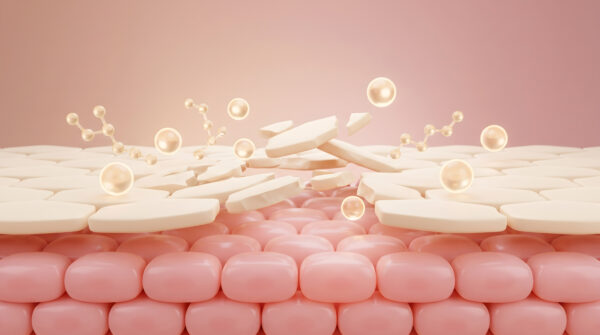
The stratum corneum exists largely to prevent excessive water loss and limit entry of external substances. That protective function is essential biologically, but it creates a practical challenge for topical formulation.
Not every active needs—or should—travel deeply into the skin. The intended destination depends on the biological target.
That is why modern delivery-system design is increasingly concerned with where an ingredient accumulates, not simply whether penetration increases.
Lipid and phospholipid-based vesicles can interact with the stratum corneum in ways that influence how encapsulated materials partition into skin. Their properties—including size, lipid composition, flexibility, and surface characteristics—can affect delivery behavior.
This makes “more penetration” an incomplete goal.
Better delivery is targeted delivery.
Formulation takeaway: The right destination matters more than simply going deeper.
Controlled Release Changes the Timing
Delivery also has a time dimension.
An active delivered immediately and an active released progressively over several hours may behave very differently, even if the total amount applied is identical.
Liposomes and other vesicular carriers have been studied extensively for their ability to provide controlled or sustained release, while also helping protect encapsulated materials.
For formulators, this creates another design variable.
Instead of thinking only about dose, we can begin thinking about:
- How quickly the active becomes available
- How long useful concentrations can be maintained
- Whether rapid release is desirable
- Whether slower delivery may improve the overall formulation experience
This is particularly relevant when working with actives whose performance is limited by instability or whose concentration at the skin surface can affect tolerability.
Formulation takeaway: Delivery is not only about where. It is also about when.
The Carrier Can Be Part of the Performance
Traditional formulations often treat the active and its vehicle as two separate things.
Advanced delivery systems blur that distinction.
Phospholipid vesicles are structurally similar to biological membranes and can encapsulate both hydrophilic and lipophilic materials depending on where the active is incorporated within the vesicle.
That creates opportunities to design delivery around the active itself rather than force every ingredient into the same formulation architecture.
Different systems can be designed to favor surface deposition, epidermal delivery, follicular targeting, or adhesion to the hair fiber.
In other words, the carrier is no longer simply transportation.
It can help determine the destination, release pattern, stability, and ultimately the amount of functional active available where it matters.

Delivery Is Part of Active Selection
The next generation of active formulation is forcing us to reconsider what defines a “high-performance” ingredient.
Concentration still matters.
Mechanism still matters.
Clinical and instrumental data still matter.
But delivery matters too.
A sophisticated active that degrades quickly, remains trapped in the wrong phase, or fails to reach its intended skin environment may never realize the performance suggested by its underlying biology.
Encapsulation and advanced carrier technologies give formulators another set of tools for addressing those limitations.
And that changes the formulation question from:
“How much active are we adding?”
to:
“How much functional active reaches the place where we need it?”
That is why, in the next generation of active ingredients, delivery changes everything.
Put Delivery to Work in Your Formula
Explore advanced active technologies designed to address stability, targeting, and controlled delivery in modern personal care formulations.
Stay Ahead of What’s Next
Subscribe for formulation insights, ingredient technologies, product updates, and emerging personal care trends.
Resources
Zhou, H., et al. (2021). Current Advances of Nanocarrier Technology-Based Active Cosmetic Ingredients for Beauty Applications. Clinical, Cosmetic and Investigational Dermatology.
https://pmc.ncbi.nlm.nih.gov/articles/PMC8286087/
Jun, S.-H., et al. (2021). Synthesis of Retinol-Loaded Lipid Nanocarrier via Vacuum Emulsification to Improve Topical Skin Delivery. Polymers.
https://pmc.ncbi.nlm.nih.gov/articles/PMC7962639/
Oliveira, C., Coelho, C., Teixeira, J. A., Ferreira-Santos, P., & Botelho, C. M. (2022). Nanocarriers as Active Ingredients Enhancers in the Cosmetic Industry—The European and North America Regulation Challenges. Molecules.
https://pmc.ncbi.nlm.nih.gov/articles/PMC8911847/
Lens, M. (2025). Phospholipid-Based Vesicular Systems as Carriers for the Delivery of Active Cosmeceutical Ingredients. International Journal of Molecular Sciences.
https://pmc.ncbi.nlm.nih.gov/articles/PMC11942248/
Citation Note: These open-access scientific references provide background on cosmetic nanocarriers, phospholipid vesicles, controlled delivery, active protection, skin penetration, and retinol encapsulation. They support the educational discussion of delivery-system science and should not be interpreted as substantiation for any individual commercial ingredient.