Skin Renewal: More Than Just Cell Turnover
Skin is constantly changing.
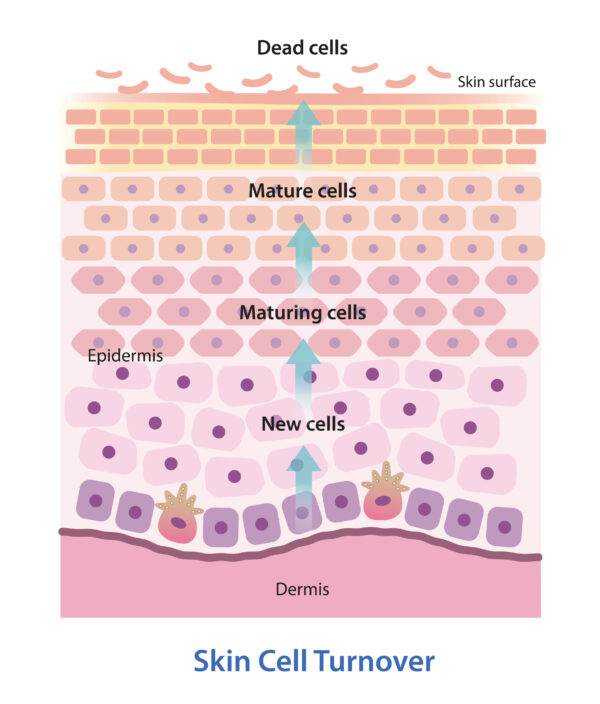
Cells are produced, transformed, moved through the epidermis, incorporated into the barrier, and eventually released from the surface.
We often compress all of that biology into one phrase:
Cell turnover.
But epidermal renewal is much more organized than that.
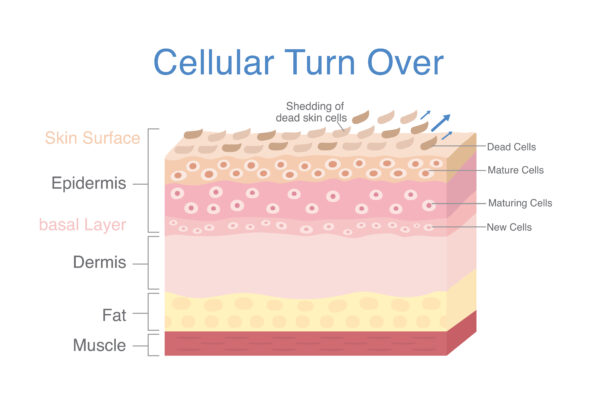
The epidermis is a continuously renewing tissue in which keratinocytes begin in the deeper basal layer and undergo a carefully regulated differentiation process as they move toward the surface. Along the way, their structure, protein expression, lipid organization, and biological function all change.
🔄 Renewal Begins at the Basal Layer
At the bottom of the epidermis sits the stratum basale.
This layer contains proliferating keratinocytes capable of generating new cells. Some of those cells remain associated with the basal compartment, while others begin a differentiation program and move upward through the epidermis.
That continuous supply of cells allows the tissue to replace cells that are eventually lost from the surface.
But producing a new cell is only the beginning.
As keratinocytes leave the basal layer, their biological role starts to change.
🧬 Differentiation Changes the Cell
Keratinocytes do not simply travel upward unchanged.
As they move through the epidermis, they progressively differentiate.
That means their gene expression, protein composition, shape, structure, and function evolve as they transition through the different epidermal layers.
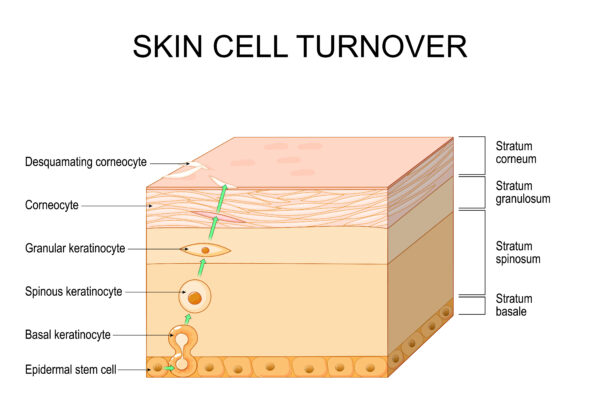
During this journey, cells move through distinct stages associated with the:
🧬 Stratum basale — where proliferation begins
🔄 Stratum spinosum — where differentiation progresses
🛡️ Stratum granulosum — where cells undergo further structural changes associated with barrier formation
✨ Stratum corneum — where terminally differentiated corneocytes form the skin’s outer protective layer
The result is not simply a new cell.
It is a cell that has been progressively remodeled for a completely different job.
🛡️ Renewal Is Also Barrier Construction
One of the most important outcomes of epidermal differentiation is formation of the stratum corneum.
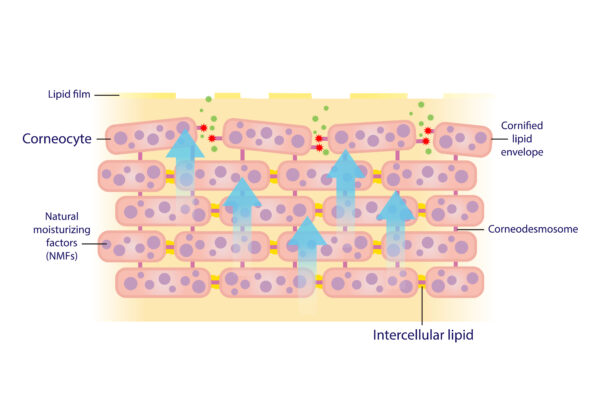
Here, terminally differentiated keratinocytes become corneocytes embedded within an organized extracellular lipid environment.
Together, these structures form the outer barrier that helps limit excessive water loss and protect underlying tissue from the external environment.
This means epidermal renewal and barrier function are closely connected.
If differentiation is the journey, barrier formation is one of its major destinations.
✨ The Final Step Is Desquamation
Once corneocytes reach the outermost surface, they do not remain there indefinitely.
They are gradually shed through desquamation.
Importantly, desquamation is not simply dead skin cells being mechanically rubbed away.
It is a regulated biological process involving enzymes that progressively weaken the structures holding neighboring corneocytes together.
That controlled shedding helps maintain a relatively consistent thickness of the stratum corneum even while new cells continue arriving from below.
So healthy epidermal renewal requires balance between:
🔄 New cell production
🧬 Differentiation
⬆️ Upward migration
🛡️ Barrier formation
✨ Surface shedding
All five processes must remain coordinated.
⏱️ Is Skin Turnover Really 28 Days?
The familiar “28-day skin cycle” is useful shorthand, but it should not be treated as a universal biological constant.
Published estimates vary. One major review, for example, describes human epidermal turnover as approximately 40–56 days, while other literature reports shorter estimates depending on how renewal is defined and measured.
Turnover can also vary with age, anatomical site, physiological conditions, and methodology.
For formulators, the more useful concept is not memorizing one number.
It is understanding that epidermal renewal is continuous, dynamic, and regulated.
🔬 Renewal Is Not the Same as Exfoliation
This distinction matters in cosmetic formulation.
Exfoliation generally refers to helping remove cells from the outer surface.
Epidermal renewal describes the much larger biological process occurring throughout the epidermis.
An exfoliant may influence what happens at or near the surface, but that is not equivalent to controlling the entire renewal cycle.
Keeping those concepts separate helps prevent exaggerated claims and creates a clearer formulation story.
🧪 What This Means for Formulators
When an ingredient is positioned around renewal, resurfacing, or skin revitalization, it helps to ask exactly what has been measured.
For example:
🔬 Was keratinocyte proliferation evaluated?
🧬 Were differentiation markers measured?
✨ Was desquamation or surface texture assessed?
🛡️ Were barrier-related endpoints included?
📊 Was the evidence cellular, instrumental, clinical, or some combination?
Those distinctions can make two seemingly similar “renewal” ingredients biologically very different.
🔄 Inside Skin Biology: The Complete Picture
This week began with communication.
Cells exchange signals that help coordinate behavior.
Then we looked at cellular energy.
Those biological responses require metabolic resources.
Now we arrive at renewal—the organized process through which new epidermal cells are generated, differentiated, incorporated into the barrier, and eventually shed.
Together, these processes reveal something important:
Healthy-looking skin is not the result of one isolated pathway.
It emerges from interconnected biological systems working continuously beneath the surface.
And for formulators, understanding those systems creates a stronger foundation for deciding not only what an ingredient does, but where it fits within skin biology.
Build Renewal Into Your Strategy
Explore ingredients and formulation approaches designed around the biology of skin renewal, differentiation, and barrier function.
Request Formulation Support
Keep Exploring Skin Biology
Follow our latest cosmetic science, ingredient insights, and formulation ideas.
Subscribe to the Newsletter
Ghazizadeh, S. & Taichman, L.B. (2015). Dermal Contributions to Human Interfollicular Epidermal Architecture and Self-Renewal. International Journal of Molecular Sciences, 16(12), 29442–29456.
https://pmc.ncbi.nlm.nih.gov/articles/PMC4691026/
Koster, M.I. (2009). Making an Epidermis. Annals of the New York Academy of Sciences, 1170, 7–10.
https://pmc.ncbi.nlm.nih.gov/articles/PMC2861991/
Hänel, K.H. et al. (2013). Cytokines and the Skin Barrier. International Journal of Molecular Sciences, 14(4), 6720–6745.
https://pmc.ncbi.nlm.nih.gov/articles/PMC3645662/
Citation Note: This article is intended for educational discussion of cosmetic skin biology. References describe established epidermal renewal, differentiation, barrier formation, and desquamation processes and should not be interpreted as therapeutic or pharmaceutical claims for cosmetic products.