Brought to you by:

How to Replace Lanolin in Modern Formulas Without Sacrificing Feel
Lanolin replacements fail most often in one place: the hand feel. You can match viscosity, even gloss—then a panel rubs it in and says, “It’s close… but it doesn’t behave like the original.” That reaction usually traces back to lanolin’s real job in a formula: it’s not a single sensory attribute. It’s a bundle—shine plus cushion, grip plus slip, and a film that stays coherent through wear.
At the same time, “lanolin-free” briefs aren’t going away. For many brands, lanolin triggers immediate questions about animal origin and vegan positioning. For others, the driver is risk management: lanolin can be associated with allergic contact dermatitis in a subset of consumers, particularly those already dealing with compromised or inflamed skin. And even when lanolin is used safely (which it often is), modern product teams are increasingly asked to deliver the same sensory payoff using plant-derived systems.
This post lays out a practical, figure-led approach to replacing lanolin without sacrificing the “balm effect.” We’ll use Natura-Tec Plantsoft™ L as the working example—what the supplier figures show, and what that means at the bench for your formulation choices.
Why Lanolin Replacement Briefs Keep Coming Up
Lanolin is widely used because it performs—especially in hand care, barrier creams, balms, and “repair” textures. It can also be used safely when formulated appropriately, and safety reviews exist for lanolin-derived ingredients.
But product development rarely happens in a vacuum. Three pressures tend to drive lanolin replacement:
1) Animal-origin avoidance and vegan positioning. Vegan beauty positioning is no longer niche; it’s a recurring brief driver that influences ingredient selection and claims language across brands and contract manufacturers.
2) Sensitivity risk management. The prevalence of lanolin allergy is debated and depends on the population studied, but dermatology literature consistently points to contact allergy in patch-tested dermatitis patients, with higher relevance in specific subgroups (e.g., chronic dermatitis contexts).
3) Portfolio and retailer constraints. “Free-from” standards, retailer requirements, and internal brand policies can force a change even if the incumbent ingredient is technically performing.
The key is not to treat lanolin as a generic emollient to be swapped one-for-one. You get better outcomes when you replace the sensory system.
What Lanolin Really Does in a Formula: The Sensory “Job Description”
When formulators say lanolin is “hard to replace,” they’re usually describing this combination:
- Shine that reads rich, not oily
- Cushion/thickness without drag
- Grip/tack that improves payoff (especially in balms and high-substantivity creams)
- Elastic/filamentous behavior—that stringy, cohesive pull during rub-out
- A coherent film that feels protective, not brittle.
If you only chase one dimension (like gloss), you can end up with a slippery ester profile that looks good on paper but feels thin. If you only chase structuring, you can get a waxy “snap” that loses the soft, continuous film consumers expect.
That’s why the most useful way to evaluate a lanolin replacement is with structured sensory and performance figures—then translate them into formulation decisions.
Sensorial Profile (Radar)
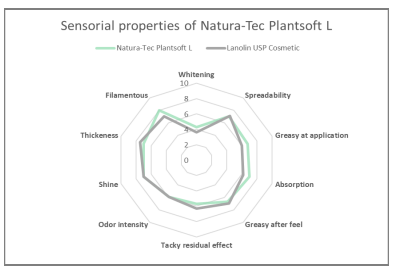
Sensorial profile comparison (supplier comparative test). Lanolin USP and Natura-Tec Plantsoft™ L were evaluated at 10% in an emulsion system, showing very similar sensorial characteristics across spreadability, shine, texture/thickness, and odor intensity.
What it means at the bench:
Start your swap as a matched-% replacement in the same phase, then validate the “balm effect” with a quick rub-out panel (shine → cushion → grip). The supplier notes a slightly less greasy and less tacky after-feel for Plantsoft™ L, which can be an advantage for rich body care—but it’s also your cue to tune film/grip if your original relies on tack for payoff.
Water Absorption Study (4x vs 2x)
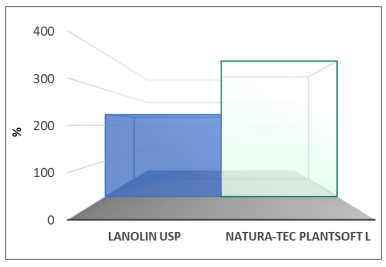
Water absorption comparison (supplier comparative test). Natura-Tec Plantsoft™ L is reported to absorb 4× its weight in water, compared with 2× for Lanolin USP under the supplier test conditions.
What it means at the bench:
This is a practical signal for “hydrated barrier feel”—systems that bind water while forming a coherent film often feel more comfortable over time, especially in hand and body textures. Use it as a formulation clue (film comfort + persistence), not a standalone hydration claim.
Moisturizing Study (5% over 5 days)
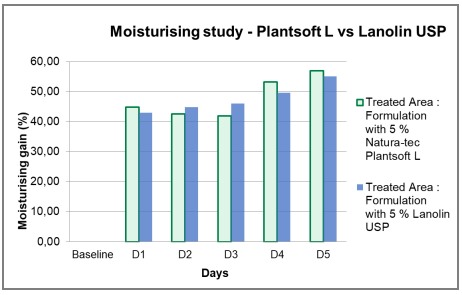
Moisturizing study over 5 days (supplier comparative test). Moisturizing properties of Natura-Tec Plantsoft™ L and Lanolin USP are reported as comparable, with both ingredients showing a cumulated effect of moisturizing gain in the supplier study.
What it means at the bench:
This supports using Plantsoft™ L in programs where lanolin is chosen for comfort over repeat use (e.g., hand creams, barrier body care). Treat it as directional evidence and validate in your base with a short wear check (immediate + later timepoints) rather than over-interpreting the absolute numbers.
TEWL Study (vs Lanolin vs Vaseline)
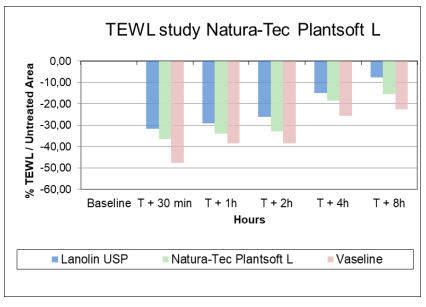
EWL study (supplier comparative test). The supplier reports Plantsoft™ L reduces TEWL more than Lanolin USP, but less than Vaseline, which is noted as occlusive.
What it means at the bench:
This is a useful way to discuss barrier-supportive film behavior without claiming full occlusion. In practice, it helps you position Plantsoft™ L as supporting “protective comfort” while still leaving room to tune occlusivity with the rest of the oil/wax system.
Viscosity Comparison (10% in an emulsion)
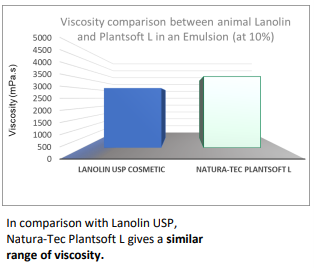
Viscosity comparison in a model emulsion at 10% (supplier comparative test). Compared with Lanolin USP, Natura-Tec Plantsoft™ L is reported to give a similar range of viscosity under the supplier test conditions.
What it means at the bench:
This matters for scale-up risk: if viscosity stays in-range, you’re less likely to trigger rework loops tied to mixing, filling, or texture drift. Use it as a starting expectation—then confirm with your own stability screen because rheology is base-dependent.
What Plantsoft™ L Is, Structurally
Plantsoft™ L is a blend built around Butyrospermum Parkii (Shea) Butter, Glyceryl Rosinate, and Olea Europaea (Olive) Oil Unsaponifiables.
Natura-Tec’s sustainability and skin affinity statement frames this synergy as forming a cohesive, biomimetic lipid network that supports compatibility, stability, and a protective, nourishing feel comparable to lanolin-based systems.
If you’re thinking like a formulator, that matters because it’s describing a structured lipid system, not a single emollient. Structured systems are often what you need when the brief is “lanolin-like behavior,” not “any emollience.”
Sustainability That Can Be Stated Clearly—Without Overreach
If you’re writing “lanolin replacement” today, you’re also writing into sustainability scrutiny. This is where specificity matters.
Natura-Tec explicitly positions Plantsoft™ L as:
- A plant-based alternative to animal-derived lanolin
- Aligned with green chemistry, circular economy, responsible sourcing, and ethical formulation principles
- Built with an upcycling strategy, recovering olive oil unsaponifiables from olive oil production by-products
- Designed with a local sourcing approach for Mediterranean olive and pine derivatives to support traceability and reduce transport-related impacts
- Sourced with sustainable forestry practices for pine rosin collection that preserves long-term forest health
For brands that need “lanolin-free” and a defensible sustainability narrative, this is the kind of language that holds up: it’s specific, bounded, and avoids vague claims.
A Bench-First Workflow for Lanolin Replacement
Here’s a simple workflow that tends to reduce rework:
1) Benchmark your incumbent lanolin formula.
Write down what “success” means using the sensory job description: shine, cushion, grip, elastic payoff, after-feel.
2) Swap at matched percentage—don’t guess.
Plantsoft™ L is described as a vegetable base alternative to lanolin, with comparable viscosity range and similar sensorial characteristics in an emulsion system. Start matched, then tune.
3) Tune the system only after you see what moved.
- Lost grip? Adjust film formers or structuring balance.
- Too heavy? Rebalance oil phase or reduce waxy structuring.
- Not enough cushion? Adjust internal phase volume or lipid structuring.
4) Validate stability quickly.
Because Plantsoft™ L is positioned as enhancing substantivity and helping control viscosity, it’s worth checking viscosity drift and phase stability early.
This keeps your development grounded in observable deltas, not ingredient mythology.
One Practical Note on Grade Selection: L vs LUX L
Per Natura-Tec’s guidance, customers can use one or the other grade because they have the same properties; the main difference is the INCI, and the LUX L grade was proposed to support EWG considerations (Plantsoft™ L: Glyceryl Rosinate; Plantsoft™ LUX L: Glyceryl Oleate).
For this reason, we’ve focused this post on Plantsoft™ L and its sustainability statement package. If your project is specifically driven by an INCI preference aligned with EWG-oriented screening, Plantsoft™ LUX L may be the better administrative fit—but the development logic stays the same: validate the sensory system in your base, then tune.
Closing: Don’t Replace Lanolin—Replace the Experience
A lanolin replacement that “works” isn’t the one that matches a single number. It’s the one that recreates the experience of the product: the slip-to-grip transition, the cushion under the finger, the coherent film that reads protective rather than greasy.
Plantsoft™ L is positioned to do that as a structured, plant-derived lipid complex—while supporting circular economy and responsible sourcing language that can be stated precisely. If you’re chasing lanolin-free without giving up the balm effect, the smartest move is to use the figures as your map and let your bench work confirm the route.
Resources:
- Cosmetics & Toiletries. (2024, October 28).
Ingredient Profile: Lanolin and Plant-Based Alternatives for Natural Moisturization.
https://www.cosmeticsandtoiletries.com/formulas-products/skin-care/article/22921829/ingredient-profile-lanolin-and-plantbased-alternatives-for-natural-moisturization
- Lis, K. (2024).
Hypersensitivity to Lanolin: An Old–New Problem.
PMC (open-access article).
https://pmc.ncbi.nlm.nih.gov/articles/PMC11679964/
- DermNet NZ. (n.d.).
Contact reactions to lanolin.
https://dermnetnz.org/topics/contact-reactions-to-lanolin
- Cosmetic Ingredient Review (CIR) Expert Panel. (2024).
Amended Safety Assessment of Lanolin-Derived Ingredients.
https://www.cir-safety.org/sites/default/files/TAR_Lanolin_032024.pdf
- BeautyMatter. (2024, December 8).
Beyond the Label: Inside the Complexities of Vegan Beauty.
https://beautymatter.com/articles/inside-the-complexities-of-vegan-beauty
- Natura-Tec (Ceratec Sarl). (2019, February).
Plantsoft™ L Product Data Sheet (PDS).
https://www.deverauxspecialties.com/wp-content/uploads/2024/09/plantsoft-l-pds_02-2019.pdf
- Natura-Tec (Ceratec Sarl). (2026, February).
Plantsoft™ L Raw Material Information (RMI).
https://www.deverauxspecialties.com/wp-content/uploads/2026/02/natura-tec-plantsoft-l-rmi-1.pdf
Citation note:
- The dermatology sources (PMC review; DermNet) support why some teams pursue lanolin alternatives (sensitivity risk management) without implying lanolin is broadly unsafe.
- CIR provides safety-context balance so the argument stays credible for technical readers.
- Cosmetics & Toiletries and BeautyMatter provide industry framing for formulation and market briefs (plant-based/vegan drivers).
- Natura-Tec documents are used for the specific product claims, figures, and sustainability language, keeping statements bounded to supplier-supported content.