
Executive Summary
When formulas rely on a growing “support stack” to fix feel, stability, dispersion, and wear, development slows—and risk goes up. This article shows why multifunctional ingredients are becoming a practical optimization tool for modern cosmetics, then uses a single multifunctional ester system as a case study that pulls multiple levers at once: soft-film sensorials, conditioning, co-/self-emulsification support, pigment wetting, and SPF-support positioning. The result is a clearer path to simpler, more predictable formulas—without sacrificing the performance consumers notice.
If your formula needs six “helpers” to feel right, stay stable, and wear well, the problem usually isn’t the concept—it’s the support stack.
In today’s development reality, complexity sneaks in quietly. A formula starts simple, then absorbs “just one more” ingredient to fix slip, then another to stabilize, then another to keep pigments from streaking, then another to help wear. Each add-on may solve a local problem, but together they create a system that’s harder to scale, harder to troubleshoot, and easier to destabilize.
That’s why multifunctional ingredients have become a serious formulation strategy—especially when timelines are tight and the brief demands both performance and simplicity. Industry coverage has called out this shift directly: multifunctional technologies are increasingly used to simplify formulas while supporting multiple performance goals. In parallel, scientific literature reviews describe multifunctional cosmetic ingredients as materials that can replace multiple single-purpose ingredients and help streamline formulation design.
In this blog we’ll define what multifunctional really means in formulation terms, identify the five performance levers that most often drive “support-stack creep,” and then show how Abysoft™ (the ingredient featured here) aligns with those levers through documented roles and supplier data.
Why Multifunctional Ingredients Matter More Than Ever in Formulation Development
Most product failures don’t happen because an active “doesn’t work.” They happen because the surrounding architecture doesn’t hold up: texture changes in heat, pigments settle, a sunscreen feels greasy, a hybrid tint streaks, or the emulsion becomes sensitive to minor processing shifts.
A long support stack increases that risk. Every added emulsifier, dispersant, rheology modifier, or sensorial adjuster adds new interactions. That can mean more sensitivity to shear, order-of-addition, raw material variability, or package compatibility. Multifunctional ingredients reduce interaction load when they truly deliver more than one bench-meaningful function.
Industry media has described this “less, but smarter” approach as a major direction in ingredient innovation—especially for teams trying to simplify formulas while maintaining premium sensorials. Scientific review work reinforces the same idea: multifunctionals can consolidate roles and streamline formulation design. The practical takeaway is not that every formula should be minimal—it’s that complexity should be earned, not accidental.
What Counts as a True Multifunctional Ingredient at the Bench
“Multifunctional” shouldn’t mean “vaguely helpful.” It should mean you can point to distinct formulation levers—properties that move measurable outcomes:
- Sensorics: slip, cushion, rub-out, dry-down, afterfeel
- Film behavior: softness, uniformity, comfort, perceived barrier
- Emulsion support: co-emulsification, self-emulsification, stability margin
- Wetting/dispersion: improved pigment wetting, uniformity, payoff, reduced processing pain
- Performance support: outcomes tied to structure and distribution (for example, sunscreen performance can change with emulsifier systems and booster choices)
One useful “reality check” is regulatory function listings. In the EU’s CosIng database, the INCI associated with Abysoft (Crambe Abyssinica Seed Oil Phytosterol Esters) is listed with functions including surfactant–emulsifying and film forming, alongside conditioning roles—consistent with a multifunctional profile.
Abysoft™ in One Line: A Multifunctional Designed to Replace a Support Stack
Abysoft is positioned as a multifunctional performance enhancer that can act as a sensorial agent + moisturizer + co-/self-emulsifier + pigment wetting agent + SPF booster.
That positioning matters because it maps to the exact places where formulas often get overbuilt.
Instead of treating “multifunctional” as a marketing adjective, we’ll evaluate it as a formulation strategy: does one ingredient pull multiple levers that normally require multiple ingredients? In Abysoft’s case, the supplier materials anchor those claims in described function, comparative emulsification performance, moisturization/conditioning data, and pigment-wetting behavior.
The Five Levers That Drive Support-Stack Creep—and How Abysoft Addresses Them
1) Multifunctional Sensorics: Soft Film Feel Without Greasy Drag
Texture and afterfeel are often the reason the support stack grows. A formula gets “almost there,” then a greasy residual appears, then the team adds more powders, more esters, more sensory modifiers—each solving one narrow issue.
Abysoft is presented as creating a protective veil—a “second skin”—with no greasy residual effect.
For a formulator, this suggests a lever that can reduce how many separate materials you need to build cushion, slip, and comfort while still achieving a refined dry-down.
The strategic point: when one ingredient improves film comfort and contributes to other structural functions (like emulsification support or pigment wetting), you can simplify the emollient blend rather than continuously patching it.
2) Multifunctional Hydration Support: Conditioning Without the Classic Tack Trade-Off
Hydration is easy to claim; hydration that feels good is harder. Humectants can bring tack, and heavier occlusives can bring residue—both of which trigger more adjustments downstream.
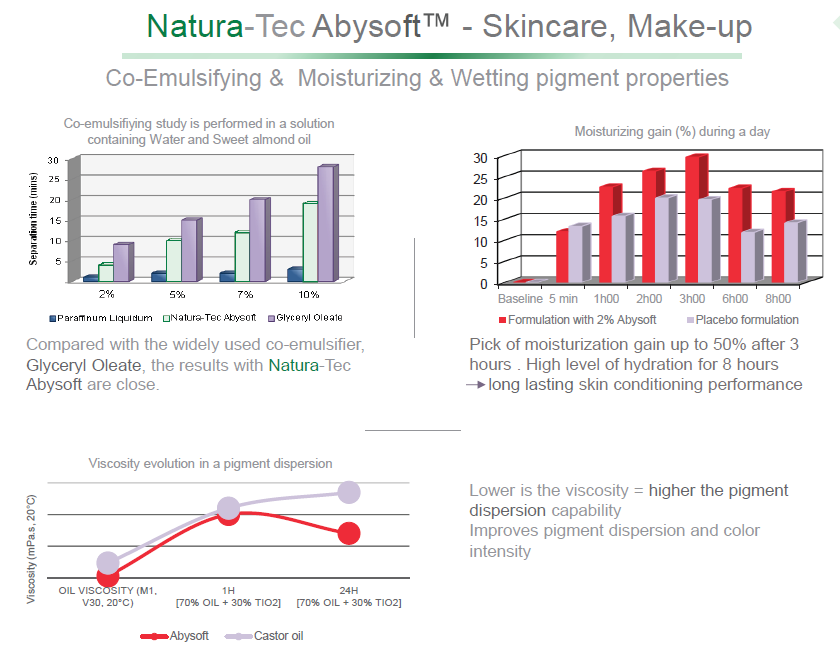
The supplier materials show a moisturizing gain up to ~50% after 3 hours and conditioning benefits reported up to 8 hours (within the presented test).
Even if every formula behaves differently, this supports the idea that Abysoft isn’t only a sensorial ingredient—it’s positioned to contribute to measurable conditioning.
A multifunctional that supports moisturization while improving afterfeel can let you tighten the system: fewer “feel correctors,” fewer compensating powders, and a cleaner path to a premium sensory profile.
3) Multifunctional Emulsion Efficiency: Co-/Self-Emulsification That Builds Stability Margin
Some formulas are “stable,” but only within a narrow window. Scale-up, temperature cycling, or a raw material lot change can expose that fragility. Multifunctionals that add emulsification support can widen the stability window and reduce late-stage rescue work.
Abysoft is explicitly positioned as a co-emulsifier and self-emulsifier, with supplier comparison suggesting performance close to a benchmark co-emulsifier (glyceryl oleate) in the presented data.
That is exactly the kind of lever that can reduce the need for multiple co-emulsifiers or “helper” surfactants added late in development.
This becomes even more important in sunscreen-adjacent systems, where emulsifier and booster choices can influence performance characteristics and sensory outcomes. A peer-reviewed open-access study evaluating emulsifiers and SPF booster levels illustrates that these formulation decisions can affect SPF and other properties.
4) Multifunctional Pigment Wetting: Cleaner Dispersion, Better Payoff, Fewer Processing Headaches
Pigment issues can be costly because they often show up late: streaking, uneven payoff, shade drift, viscosity surprises, or stability failures in storage. When wetting is weak, you compensate with dedicated dispersants, then correct feel, then correct stability.
Abysoft is presented as a pigment wetting agent, and the supplier materials show reduced viscosity in pigment dispersions and increased color intensity—signals consistent with improved wetting/dispersion behavior.
The value here is not just aesthetics. Better wetting can improve processing efficiency and reduce the need for additional dispersant systems.
If you work on tinted skincare, hybrid complexion products, or tone-up formats, pigment wetting is rarely optional—and a multifunctional that supports wetting while also improving feel is a powerful consolidation tool.
5) Multifunctional Performance Support: SPF Boosting Framed Responsibly Through Film and Distribution
Abysoft is positioned as an SPF booster.
The responsible framing is not “add this and get SPF.” The responsible framing is structural: sunscreen outcomes depend on more than filter selection alone. Film quality, spread uniformity, and system structure can influence performance.
That’s not conjecture. Research evaluating emulsifier substitution and SPF booster concentration shows that these choices can impact sunscreen performance characteristics and related physical properties.
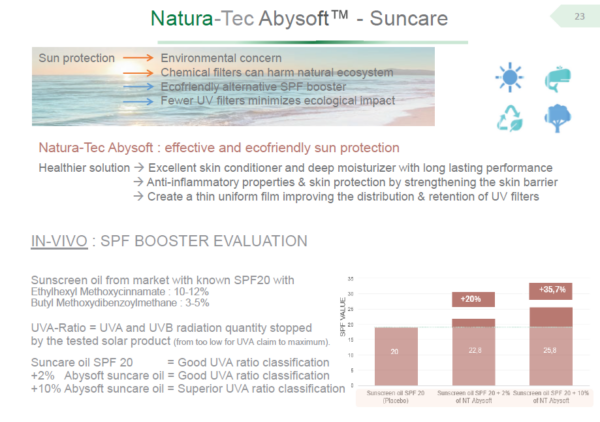
So the formulation logic is simple and defensible: a multifunctional that supports film comfort, distribution, and structural cohesion can be part of a strategy to improve performance while improving consumer experience.
Where Multifunctional Ingredients Win: Formats That Reward Consolidation
Abysoft’s multifunctional profile maps cleanly to three development “pain zones” where support stacks grow quickly:
1) Daily moisturizers that must feel premium with fewer ingredients
When the brief includes “simple” and “elegant,” you need ingredients that deliver both structure and sensory refinement. Abysoft’s soft-film, non-greasy positioning plus moisturization support makes it relevant here.
2) Pigmented skincare, primers, and hybrid complexion products
Any pigment system benefits from strong wetting and stable dispersion. If one multifunctional contributes to wetting, feel, and structure, it can replace several “helpers” that otherwise accumulate.
3) Sunscreen-adjacent formulas where elegance and structure are inseparable
SPF formats are unforgiving: consumers judge spread, residue, and comfort immediately, and performance can depend on how the film organizes. Literature supports that emulsifier/booster choices influence these outcomes.
A Practical Test: When a Multifunctional Ingredient Earns Its Place
A multifunctional earns its place when it reduces total risk—not just total ingredient count.
Use this decision filter during development:
- Does it replace at least two dedicated helpers?
- Does it reduce interaction load? (fewer surfactant conflicts, fewer rheology compensations)
- Does it improve both perception and structure? (feel and measurable behavior)
- Can you explain it clearly to brand and R&D without hype?
- Is the function profile supported by credible sources? (supplier data + independent context + regulatory function listings)
Abysoft aligns strongly with this framework because it is positioned across multiple levers and supported by supplier data and function listings consistent with emulsifying and film-forming roles.
How to Position Abysoft as a Competitive Solution Without Overclaiming
Technical audiences don’t want slogans—they want a formulation narrative:
- Problem: support-stack creep increases instability risk and slows iteration
- Mechanism: consolidate multiple levers into fewer materials, reducing interactions
- Result: simpler, more predictable formulas that keep performance and sensorial quality
The cleanest positioning is: “a multifunctional ingredient that helps you build a smarter support system.” That gives R&D a bench-relevant reason to trial it and gives brand teams a credible story that doesn’t rely on hype.
Conclusion: Multifunctional Ingredients Aren’t About Less—They’re About Better Control
Multifunctional ingredients matter because they change how you design a formula: fewer patches, fewer interactions, and fewer surprises. When one ingredient can meaningfully support film feel, emulsification, pigment wetting, conditioning, and performance strategies, it can reduce complexity and increase confidence.
Abysoft is a practical case study of that approach: positioned as a sensorial agent, moisturizer, co-/self-emulsifier, pigment wetting agent, and SPF booster—with supplier data supporting the direction of these functions.
If your current workflow includes repeated “add one more ingredient” cycles to fix feel, stability, and payoff, the most effective change may not be a new active. It may be a better support architecture—and that’s where multifunctional ingredients earn their place.
Abysoft™ FAQs
Start where you can observe multiple levers at once—sensorial feel, film comfort, and processing behavior (especially in pigmented systems). Use-level targets should be confirmed in your finished base with stability and any claims testing you plan to make.
In most systems, Abysoft™ is easiest to handle by incorporating it into the oil phase (or an oil premix), then emulsifying as usual. If you’re using it as a consolidation tool (emollient + co-emulsification support), prototype with your existing emulsifier package first and track viscosity drift, freeze/thaw, and heat stability to confirm the simplified system stays robust.
When a multifunctional supports pigment wetting, you’ll usually see faster dispersion development and a more uniform film. In practice, watch for reduced streaking, improved color payoff, and fewer viscosity surprises after adding your pigment package—especially in tinted skincare, hybrid complexion formats, and pigment-containing SPF products.
Treat “SPF support” as a formulation-structure hypothesis, not a shortcut. Screen for improved spread/film feel at bench, but validate performance using the appropriate in vitro and/or in vivo SPF/UVA methods for your region and claim strategy. If you change emulsifiers, boosters, or oils, re-test—because film structure and distribution can change outcomes.
Because the goal is to reduce “helper” ingredients, the key checks are the ones that expose hidden dependencies: phase stability, viscosity stability, pigment settlement (if applicable), and odor/color drift over time. Also confirm preservative performance in your final formula, since simplifying the support system can change microenvironments in emulsions.
Ready to evaluate Abysoft™?
Take the next step from insight to action. Review the data, download the PDS, and explore where Abysoft™ may fit into your next multifunctional formulation strategy.
Forward this article to your Deveraux account managerResources
- Global Cosmetic Industry. (2024, September 3). Beauty’s multifunctional moment: Less is so much more. https://www.gcimagazine.com/ingredients/launches-claims/article/22916129/beautys-multifunctional-moment-less-is-so-much-more
- Špaglová, M., et al. (2025). Role of emulsifiers and SPF booster in sunscreen performance: Assessing SPF, rheological behavior, texture and stability. Cosmetics, 12(3), 118. https://www.mdpi.com/2079-9284/12/3/118
- Rischard, F. (2025). A critical review from sourcing to cosmetic applications. Comptes Rendus Chimie. https://www.sciencedirect.com/science/article/pii/S0001868625000740
- Allure. (2025). Skin care trends for 2025. https://www.allure.com/story/skin-care-trends-2025
- Cosmetics Business. (2025, April 17). The rise of minimalist beauty: Why less really is more. https://cosmeticsbusiness.com/the-rise-of-minimalist-beauty-why-less-really-is-more
Citation note: These sources were selected to support the article’s core argument from complementary angles without relying on supplier marketing. Global Cosmetic Industry provides industry-facing context on why multifunctional ingredients are gaining momentum in formulation strategy. The MDPI Cosmetics paper is an open-access, peer-reviewed study showing that emulsifier/booster choices can measurably influence sunscreen performance and physical properties—supporting the broader point that “support ingredients” materially affect outcomes. The ScienceDirect review provides a scholarly foundation for multifunctional ingredient use and formulation streamlining. Cosmetics Business and Allure were used only to document the persistence of “less-but-better/minimalist” product direction shaping briefs and expectations; formulation claims in the post are grounded in the peer-reviewed and technical sources rather than consumer trend coverage.