If your “instant smoothing” formula only works on a flat surface, it won’t survive a real face. Textured skin—especially mature skin—forces every film former, polymer, and sensory choice to reveal its weaknesses in daylight, under makeup, and during facial movement.
That’s not a marketing problem. It’s a deposition problem. Cosmetic performance depends on what actually lands on the skin and stays there as a coherent film. Recent research is starting to measure cosmetic film deposition with tools like X-ray microtomography, because subjective “it looks smooth” is not enough when consumers layer sunscreen, foundation, and primers in the wild.
This article is a technical bridge for brand and R&D teams: why textured (mature) skin changes the rules of film formation, where “instant” products typically fail, and how a peptide-led strategy—using BGT™ TDP-1—can help deliver fast visible smoothing without overloading the formula with aggressive, failure-prone films.
Textured (Mature) Skin Changes the Rules of Cosmetic Film Deposition
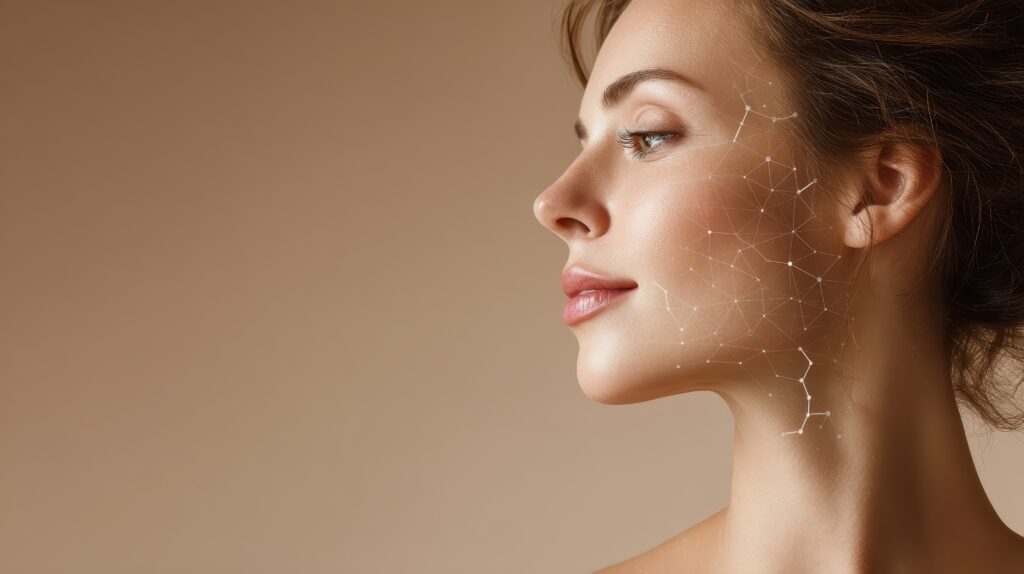
Skin is not a uniform substrate. Even before we talk about wrinkles, there’s skin microrelief—the fine network of lines and patterns that changes with age and environment. Researchers have built quantitative methods to extract microrelief parameters from skin images, precisely because surface topography is a major driver of how products look and wear.
Now add aging. Age-related changes increase roughness and introduce deeper furrows and more pronounced features. That matters because films don’t deposit like paint on glass. They distribute, evaporate, and set while interacting with peaks and valleys. A 2025 open-access study introduced an age-tailored artificial skin model specifically to study how age-related topographical changes impact cosmetic thin-film deposition, using X-ray microtomography to compare deposition behavior on young versus aged topographies.
This is a crucial reframing for product development: on textured skin, “coverage” and “smoothness” are not purely formulation promises. They are outcomes of where the product accumulates, how evenly it spreads, and whether the resulting film remains continuous as the face moves.
Why “Instant Smoothing” Often Backfires: Pilling, Patchiness, and Motion Stress
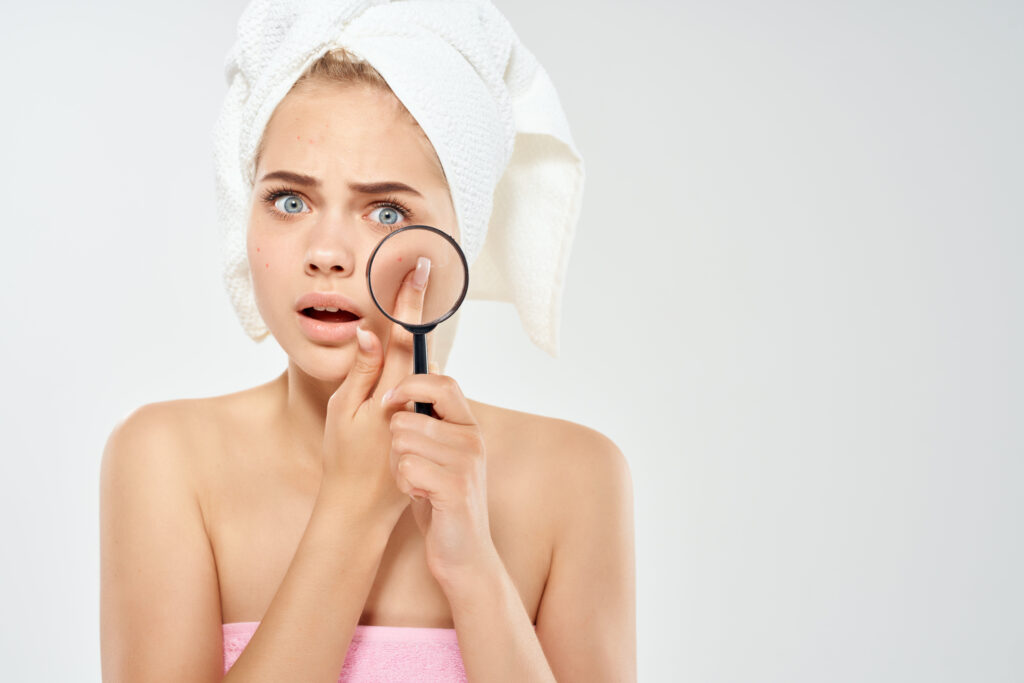
The most visible failure mode is pilling—the moment a consumer rubs lightly and the product balls up into flakes. Until recently, pilling was mostly explained in blog posts and training decks, not in controlled studies. That changed with a 2024 open-access investigation that examined pilling potential of sunscreen and foundation, looking at both skin physiology and application method. The study reported that certain rubbing motions produced more pilling events, reinforcing what formulators already suspect: friction and layer interaction can convert a borderline film into visible debris.
Pilling is often treated as a routine issue (“wait longer between steps”), but formulation is deeply implicated. On textured skin, a film may be discontinuous—thicker on ridges, thinner across valleys—making it more vulnerable to mechanical shear. Once that film fragments, the fragments can roll into pills under the right friction and compatibility conditions.
The second failure mode is patchiness and residue: a film that deposits unevenly can highlight, not hide, surface structure. Microtomography-based cosmetic film studies emphasize that what we call a “cosmetic film” is a residue layer shaped by formulation composition and drying behavior, and that quantitative analysis can connect physical deposition to consumer-visible outcomes.
The third failure mode is motion stress. “Instant tightening” systems often rely on films that contract as they dry. Contraction can create a fast perception shift, but it also introduces internal stress. If the film is brittle, facial movement can cause microcracks, flaking, or loss of uniformity. The result is the classic paradox: immediate visible change, followed by diminished elegance as wear progresses.
A Better Design Target: Thin, Flexible Films + Smarter Perception Engineering
If textured skin magnifies uneven deposition, the goal becomes clear: minimize film burden while maximizing perceived smoothing. That usually means designing films that are thin, flexible, and cohesive—not thick, highly contracting shells.
Open-access work on film-forming systems provides a useful framework for thinking about this. Film-forming formulations create a solid layer after solvent evaporation; performance depends on polymer selection, plasticization, drying behavior, and resistance to water and abrasion. While much of this literature is in dermal delivery contexts, the physical principles translate well to cosmetics: how a film forms, how it adheres, and how it withstands mechanical wear.
For brand teams, “thin and flexible” may sound like a sensory goal. For formulators, it’s a durability strategy. A flexible film can move with expression lines rather than splitting at them. A thinner film is less likely to pool, pill, or telegraph texture. And when the formula doesn’t depend on an aggressive film for the entire effect, you can dial down the very components most associated with tack, residue, and makeup conflict.
This is where “instant” becomes more defensible: not as an optical trick that collapses under real use, but as a system-level design that makes quick improvements and remains aesthetically stable.
Where BGT™ TDP-1 Fits: Fast Visible Smoothing Without Overloading the Film
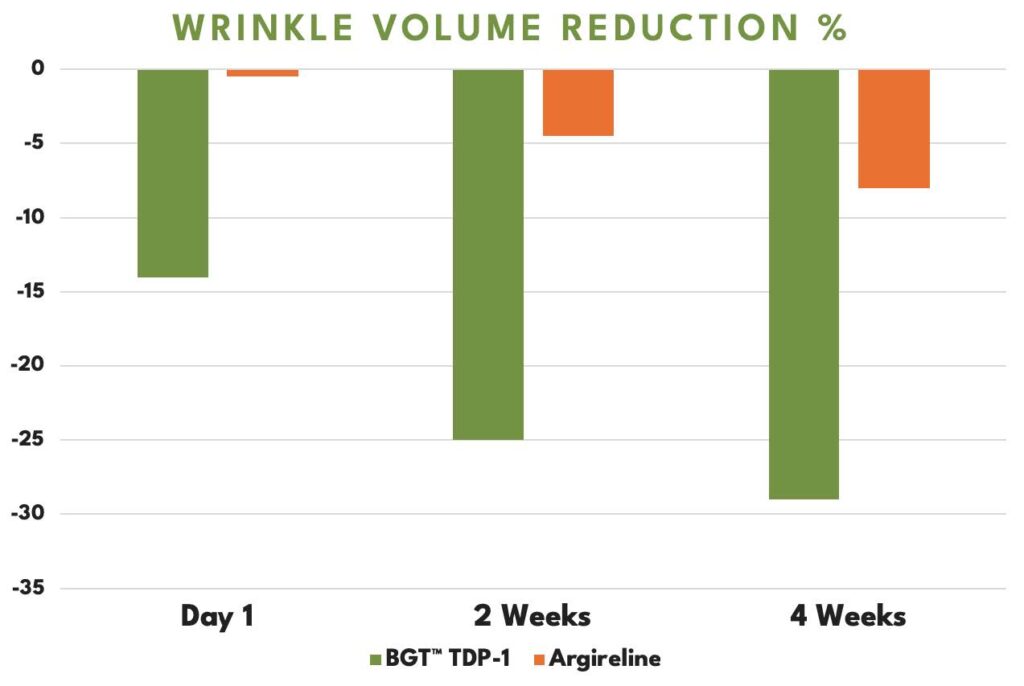
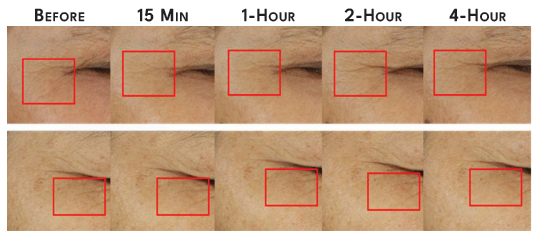
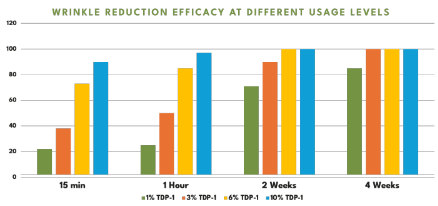
BGT™ TDP-1 is positioned as a patented anti-wrinkle peptide designed using AI and molecular docking, with a 13–amino acid sequence. In BGT’s supplier-reported evaluations, the ingredient is associated with fast visible improvement (on the order of minutes) and consumer-perceivable smoothing benefits at use levels such as 1–3% (and higher levels explored in testing).
Here’s the formulation-relevant point: a peptide-led approach can support the appearance of expression line reduction without requiring the formula to lean entirely on high-shrink “tensor” films to create the before/after moment. That matters on textured skin, where heavy reliance on film contraction increases the risks we just outlined: uneven deposition, pilling under friction, and stress cracking.
Think of it as rebalancing the system. Instead of asking one film former to do everything—instant feel, instant look change, and durable wear—you can distribute responsibilities:
- TDP-1 supports the fast “smoothing narrative” in a way that can be framed cosmetically (appearance-based).
- A lighter film architecture supports uniform deposition and wear, rather than high contraction.
- Sensory agents (emollients, silicones, powders) can be tuned for slip and set time without creating a fragile surface layer
This doesn’t remove the need for excellent film design. It reduces the pressure to use the most failure-prone film strategies—especially in leave-on products that must perform under sunscreen, foundation, and consumer application variability.
Formulator Checklist: How to Screen for Real-World Performance on Textured Skin
Textured skin performance is not something you verify at the end. You build it into screening. The 2024 pilling study highlights how application method influences pilling events, which is a reminder to test beyond gentle lab spreading.
Practical early-screen tests (fast, high signal):
Deposition sanity check on textured substrates
Use textured test surfaces (or validated models when available) and evaluate uniformity after dry-down. The age-tailored artificial skin model literature reinforces that topography affects deposition measurably; you don’t need microtomography in-house to apply the idea.
Rub + recoat tolerance (the “real routine” test)
Apply product, allow a fixed set time, then rub lightly (both linear and circular) and reapply a second layer (or sunscreen/foundation analog). The pilling study’s emphasis on rubbing motions makes this a grounded stress test rather than superstition.
Motion stress simulation
Evaluate film integrity in high-movement zones (crow’s feet region analog, smile lines). Look for microflaking, cracking, or loss of uniformity over time. Film-forming literature emphasizes abrasion resistance and film durability as measurable properties—not subjective impressions.
Microrelief-aware imaging
If you’re substantiating “instant smoothing,” capture standardized images that reflect texture changes (macro + micro). Quantitative microrelief image analysis methods exist specifically to evaluate age-dependent changes and surface parameters.
The business benefit is straightforward: these tests reduce late-stage surprises—those painful moments when a formula looks good on a forearm but fails on a face in the presence of SPF, primer, or foundation.
What to Tell Brands and R&D: Claims-Safe Language That Still Sounds Exciting
Brands want “Botox-like.” Regulators want restraint. The bridge is to describe what consumers actually observe: the appearance of smoother expression lines, improved look of skin texture, more even-looking surface, and visible results in minutes when supported by appropriate testing.
The strongest positioning is not “we freeze muscles.” It’s “we engineered a system that deposits evenly and stays elegant on textured skin.” That argument is supported by the direction of current research: quantifying cosmetic film deposition with microtomography, modeling age-related topography as a critical variable, and investigating pilling as a measurable phenomenon influenced by skin physiology and application.
Where BGT™ TDP-1 supports the story is in allowing the formula to deliver a fast visible smoothing narrative without over-relying on aggressive surface films that can crack, pill, or highlight texture. If your R&D team can show good deposition and good wear on textured skin, the marketing claim becomes simpler—and more believable.
BGT™ TDP-1 FAQs
What usage levels of BGT™ TDP-1 work best in different formats?
Usage level depends on the format and the performance goal (fast “visible smoothing” vs. longer wear support). Start with the supplier’s recommended range in the technical data sheet, then bracket around that level in a short screening study.
Tip: When optimizing for textured (mature) skin, evaluate not only “after feel,” but also evenness (no patchiness), makeup compatibility, and rub resistance at multiple timepoints.
Where should I add BGT™ TDP-1 in an emulsion or serum process?
As a best practice for peptide actives, add during cool-down (or post-emulsification) once the batch is below elevated processing temperatures. This approach helps protect performance and reduces the risk of unexpected interactions during high-shear/hot steps.
Always confirm the supplier’s processing guidance (temperature, mixing, and hold time) in the TDS.
How does BGT™ TDP-1 help avoid the “tensor trap” on textured skin?
Many “instant” products rely heavily on contracting surface films that can look uneven on skin microrelief and may pill, crack, or spotlight lines during wear. A peptide-led architecture lets you pursue fast perceived smoothing while dialing down aggressive film strategies.
In development, prioritize thin, flexible films and test under real layering (SPF/primer/foundation) with rub + recoat protocols.
What pH and formula environment should I target for reliable performance?
Peptides can be sensitive to extremes of pH and to certain high-electrolyte or highly reactive environments. Aim for a pH window aligned to the supplier guidance and verify stability/performance in your specific base (especially if you’re using strong acids, high salt systems, or reactive botanicals).
If your formula includes multiple polymers/film formers, run compatibility checks (clarity, viscosity drift, and “rub-off/pilling” behavior) early.
How should I substantiate “visible in minutes” claims without overstepping cosmetic boundaries?
Keep claims appearance-based (e.g., “reduces the appearance of expression lines” / “visible smoothing”) and support them with a timepoint stack: immediate (e.g., 15–30 minutes) plus mid-wear and end-of-wear checks.
Use consistent imaging and expert grading focused on evenness on textured skin, plus consumer perception questions like “smoothness,” “comfort,” and “makeup-friendly.”
Next Steps: Prototype Pathways + How Deveraux Helps You Get There
If you’re developing for textured or mature skin, start with prototypes that respect deposition physics:
- Serum-primer hybrid: fast set, low tack, high slip; designed for layering under makeup.
- Eye-area gel-serum: low residue, controlled film, minimal migration; focus on microrelief appearance.
- Cream-serum “cushion” texture: more comfort, still thin-film behavior; designed to avoid whitening/flake.
Deveraux Specialties can support you with formulation guidance, supplier documentation, and sampling so you can pressure-test the concept quickly and build a robust story for both brand and R&D teams.
If you want to explore BGT™ TDP-1 in an instant-smoothing architecture, we can help you map it into your base, define a screening plan, and align claims language to your target markets.

Resources
- Lua, B. L., et al. (2024). Understanding the causes of skincare product pilling. International Journal of Cosmetic Science. https://pmc.ncbi.nlm.nih.gov/articles/PMC11294729/
- Gonçalves, M., et al. (2025). Age-tailored artificial skin model for cosmetic film development. https://pmc.ncbi.nlm.nih.gov/articles/PMC11919402/
- Gonçalves, M., et al. (2024). Advanced characterization of soft cosmetic film deposits with X-ray microtomography. Small Methods. https://onlinelibrary.wiley.com/doi/full/10.1002/smtd.202402202
- Pünnel, L. C., & Lunter, D. J. (2021). Film-forming formulations for dermal drug delivery. Pharmaceutics, 13(7), 932. https://www.mdpi.com/1999-4923/13/7/932
- Wu, Y., & Tanaka, T. (2021). Objective and quantitative measurement of skin micro-relief by image analysis and application in age-dependent changes. https://pmc.ncbi.nlm.nih.gov/articles/PMC9291164/
Citation note:
These five open-access papers were selected because they directly support the article’s central argument with measurable, formulation-relevant evidence: (1) pilling has now been studied experimentally and is influenced by skin physiology and application method, (2) age-related topography measurably alters cosmetic film deposition, (3) microtomography provides a quantitative lens on cosmetic film behavior, (4) film-forming fundamentals link polymer choice and drying behavior to abrasion resistance and integrity, and (5) microrelief can be quantified objectively, supporting more rigorous substantiation on textured skin.