Executive Summary
Collagen masks are gaining momentum, but rising consumer interest does not automatically translate into stronger formulas. Traditional topical collagen can help with surface hydration and short-term smoothing, yet formulators still face persistent limits around molecular size, meaningful skin interaction, and claims support. As brands chase the collagen mask trend, the real opportunity is to move beyond passive film-forming effects toward technologies that better align with the category’s promise of firmer, more resilient-looking skin. Positioned as an advanced collagen-support strategy, BGT™ mRNA-Collagen helps frame a more science-forward story for mask development, connecting trend demand with a differentiated approach to collagen expression, visible rejuvenation, and next-generation anti-aging formulation.
Collagen Masks Are Trending, But There’s a Formulation Gap
Collagen-based face masks have risen rapidly in consumer interest, driven by skincare communities and digital platforms touting their plumping, hydrating, and anti-aging effects. Market trend intelligence indicates “collagen mask” is among the fastest-growing skincare searches for 2026, reflecting a strong consumer desire for rejuvenating, immediate-appeal formats. Yet behind the trend lies a critical technical challenge: traditional collagen ingredients are not optimized to deliver meaningful effects in topical mask systems.
For cosmetic scientists and product developers, this creates both an opportunity and a risk. The opportunity is capturing consumer interest; the risk is repeating decades of formulations that provide hydration and sensory feel without addressing deeper biological or performance expectations. Understanding the science behind collagen’s benefits—and its limitations—is essential for formulating with confidence and differentiation.
What Consumers Are Really Asking For: Beyond Surface Hydration
Consumer interest in collagen masks is not a fleeting social media fad. Data indicates that search volume for collagen mask products and related terms has increased sharply year-over-year, placing it ahead of other rejuvenating formats. This trend aligns with broader demand for products promising visible hydration, skin glow, and anti-wrinkle benefits.
From a formulation perspective, collagen can deliver immediate surface hydration and a temporary smoothing effect by acting as a humectant on the skin’s outer layers. When integrated into a mask, especially in occlusive hydrogel or sheet formats, collagen can help draw and retain moisture — effects that are instantly noticeable to consumers. However, scientific evidence shows that the primary action of topically applied collagen remains at the surface rather than penetrating into deeper dermal layers where long-term structural changes occur.
This points to the heart of the formulation gap: Consumers interpret “collagen” as rebuilding or boosting skin structure, but many conventional collagen actives do not address the biological mechanisms that form new collagen in the dermis.
Traditional Collagen Technologies: Strengths and Limitations
Collagen in cosmetic formulations typically falls into a few categories:
- Native/full-size collagen proteins — large molecules that offer emollience and hydration.
- Hydrolyzed collagen peptides — broken-down fragments designed for better skin interaction.
- Collagen extracts from animal or marine sources — marketed for “natural” supply.
All forms bring safety and compatibility advantages. For example, hydrolyzed collagen is widely recognized as a safe cosmetic ingredient with moisturizing benefits at the stratum corneum layer and has been used for decades in topical products. However, multiple clinical evaluations confirm a persistent limitation: larger collagen molecules cannot penetrate deeply into skin to reach fibroblasts or directly stimulate endogenous collagen synthesis.
In contrast, clinical evidence suggests that optimized peptide fragments and lower molecular weight collagen components can interact more readily with the epidermis and superficial dermis. This can translate to improved hydration and elasticity markers in some cases, but the extent of true structural remodeling is still under study.
This biological reasoning explains why, despite strong consumer demand, many collagen mask products deliver sensations of moisture or temporary smoothing without measurable increases in dermal collagen or elasticity.
Delivery Science: Why Formulators Struggle With Collagen in Masks
The skin is a highly effective barrier. Stratum corneum cell layers, lipid matrices, and tight junctions are designed to keep large molecules out of living tissue. Collagen’s native triple helix and large molecular weight make it especially challenging to drive through that barrier.
Scientific studies on topical peptide delivery show that molecular weight, structure, and formulation vehicle dramatically influence whether an ingredient merely sits at the surface or interacts with the epidermis. Even hydrolyzed peptides — while smaller — may remain largely in the epidermal layer unless formulation mechanisms (such as encapsulation, microneedle arrays, or carrier systems) are used.
For mask products specifically, the format intensifies the challenge:
- Sheet Masks: Designed for occlusion, they tend to hold ingredients at the skin’s surface.
- Hydrogel Masks: These can enhance contact with skin water content but still rely on ingredient diffusivity.
- Bio-Cellulose & Fiber Masks: Better conform to skin topography but must pair with active carriers to improve penetration.
These dynamics help explain why conventional collagen-infused masks feel hydrating but provide limited long-term structural benefits. They improve the symptoms of dryness and laxity but do not address the underlying biology of collagen loss and synthesis.
Advanced Collagen Technology: Engineering a Better Ingredient
To address these formulation challenges, ingredient innovation has shifted toward bioactive collagen analogs engineered for better skin interaction and signaling potential.
For example, technologies that mimic the functional domains of endogenous collagen or that incorporate molecular motifs designed to interact with cell receptors can offer a pathway to biological activity beyond hydration. These advanced collagen platforms aim to balance several critical factors:
- Stability in formula: Resistance to degradation during processing and storage.
- Bioavailability: Increased ability to approach the viable epidermis or engage key pathways.
- Compatibility: Stability with pH, preservatives, and other common actives.
- Consumer sensory: Non-tacky, non-pilling, and compatible with mask substrates.
These engineered collagen materials allow formulators to deliver a performance story that aligns more closely with consumer expectations: not just instant hydration, but supporting skin structure and visible resilience.
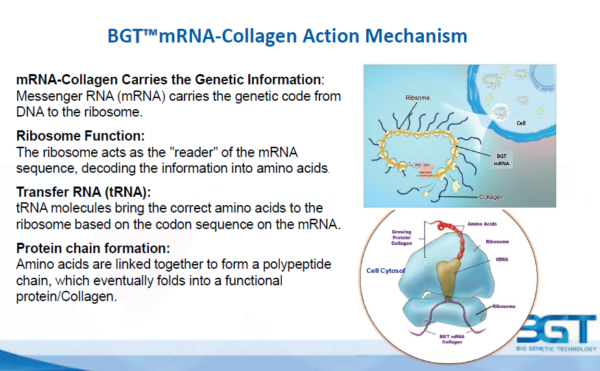
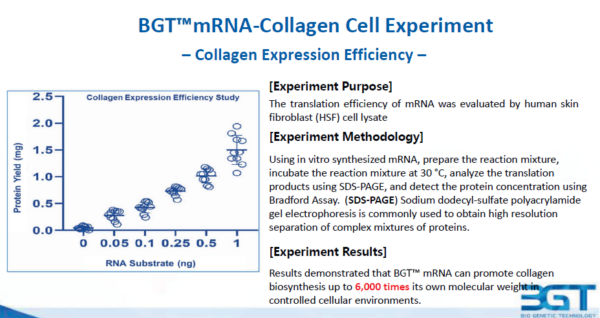
This is the category where BGT™ mRNA Collagen fits as a competitive offering. By leveraging a next-generation collagen construct designed to address stability and interaction challenges, it provides a solution more aligned with rigorous performance claims than legacy collagen peptides alone.
Bridging Consumer Trend With Scientific Rigor
As a formulator or brand strategist, three core design questions emerge when working in the collagen mask space:
1. What measurable benefits do consumers expect?
Consumers increasingly seek plumper, firmer, and visibly rejuvenated skin, not just surface moisture.
2. What can current ingredients deliver biologically?
Science shows topical collagen primarily offers hydration; true dermal signaling requires more complex material or supporting actives.
3. How can formulation choices support both sensory appeal and performance?
Selecting collagen technologies that offer stability, delivery potential, and evidence-backed benefit creates differentiation. Paired with a well-designed mask substrate, these materials better bridge the gap between consumer perception and scientific reality.
Brands that simply add conventional hydrolyzed collagen risk underwhelming results and weak claims substantiation. Those who invest in more advanced collagen platforms — and pair them with formulation technologies that enhance delivery and sensory experience — position themselves to truly benefit from the category’s momentum.
Conclusion — Science Must Catch Up With Consumer Demand
Collagen masks have earned consumer attention—and the category’s growth is not simply hype. What the science makes clear is that traditional collagen solutions, while safe and hydrating, do not realize the full expectations consumers attach to the trend.
For formulators, this creates an inflection point: the need to evolve ingredient design from hydrating proteins toward bioactive, better-delivered collagen systems that support both consumer experience and measurable skin benefit. This science-forward approach aligns product performance with the trend narrative and strengthens claims with evidence.
By leveraging next-generation collagen technologies like BGT™ mRNA Collagen, brands can bridge the gap between what consumers want (visible, structural benefits) and what formulations deliver (stable, biologically relevant activity). This evolution will define the next generation of collagen mask innovation.
BGT™ mRNA-Collagen FAQs
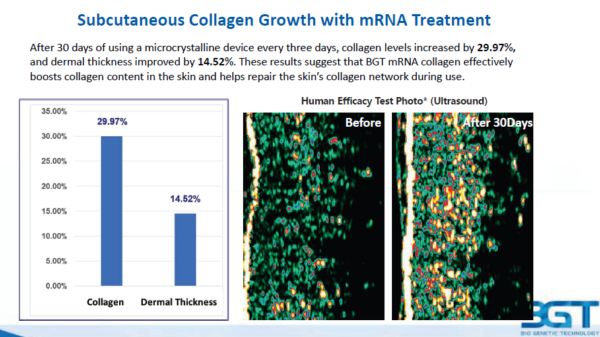
A practical starting point depends on the performance target of the finished formula. Supplier guidance positions 0.1–1% for noticeable subcutaneous collagen regeneration support with fine-line and firmness benefits, 1–5% for stronger firmness and elasticity positioning, and 5–10% when the goal is a more pronounced elasticity, firmness, and radiance story. In development, most teams should start with the lowest level that fits the desired claim set, sensory profile, and cost-in-use target, then confirm performance in the finished base.
BGT™ mRNA-Collagen is described as stable in aqueous systems, but it should not be stored for prolonged periods above 45°C. From a formulation standpoint, that makes it best suited to a cool-down or controlled late-stage addition rather than extended exposure during a hot process. Add once the batch is below the target temperature, mix gently to uniformity, and validate the exact addition point through stability testing in your own system.
Because it is supplied as a colorless, odorless aqueous RNA solution, BGT™ mRNA-Collagen is a logical fit for water-based or water-containing systems such as sheet mask essences, hydrogel masks, serums, toners, gel-creams, and lightweight emulsions. It is less naturally suited to fully anhydrous formats unless a compatible delivery strategy is built around it. For brands targeting the collagen mask trend specifically, leave-on and mask applications make the clearest technical and marketing fit.
Yes. The supplier notes that BGT™ mRNA-Collagen is sensitive to nucleases, which means biological contamination can contribute to degradation. In practice, that calls for clean handling, good GMP discipline, and care during raw material transfer and storage. Teams should avoid unnecessary contamination exposure, protect the ingredient during batching, and verify compatibility with the chosen preservation system and packaging format as part of normal stability and microbiological evaluation.
From a formulation and marketing perspective, the most relevant directions are anti-aging, firming, elasticity support, fine-line reduction, collagen-boosting support, and skin-rejuvenation positioning. Those claims align with the product story and supplier data around collagen expression, dermal thickness, wrinkle depth, skin firmness, and elasticity. As always, final wording should be based on your finished-formula testing, regional claim standards, and the level of substantiation you plan to put behind the product.
Ready to evaluate BGT™ mRNA-Collagen?
Take the next step from insight to action. Review the data, download the PDS, and explore where BGT™ mRNA-Collagen may fit into your next collagen mask or anti-aging skincare concept.
Forward this article to your Deveraux account managerResources
- Aguirre-Cruz, G., León-López, A., Cruz-Gómez, V., Jiménez-Alvarado, R., & Aguirre-Álvarez, G. (2020). Collagen hydrolysates for skin protection: Oral administration and topical formulation. Antioxidants, 9(2), 181. https://pmc.ncbi.nlm.nih.gov/articles/PMC7070905/
- Janssens-Böcker, C., et al. (2024). Native collagen sheet masks improve skin health and appearance. Journal of Cosmetic Dermatology. https://pubmed.ncbi.nlm.nih.gov/38279521/
- Pu, S. Y., et al. (2023). Effects of oral collagen for skin anti-aging: A systematic review and meta-analysis. Nutrients, 15(9), 2080. https://pmc.ncbi.nlm.nih.gov/articles/PMC10180699/
- Bar, O. (2025). Skin aging and type I collagen: A systematic review. Cosmetics, 12(4), 129. https://www.mdpi.com/2079-9284/12/4/129
- Andrei, F., et al. (2025). Topical collagen dermocosmetic benefits. Brazilian Journal of Pharmaceutical Sciences. https://www.scielo.br/j/bjps/a/QtBfKQpgFf8cWtsx6dZBN7c/?format=html&lang=en
Citation note: These sources were selected to support the article’s central argument from both a market-facing and formulation-facing perspective. Together, they help establish the difference between collagen’s familiar topical hydration and film-forming role versus the higher performance expectations now attached to collagen masks. The set includes peer-reviewed and open-access literature covering topical collagen behavior, skin-aging biology, clinical mask performance, and broader collagen efficacy context. Product-page material has been intentionally excluded here so the reference block stays focused on third-party and journal-style support.