Most aluminum-free deodorants force a trade-off: you gain a cleaner label, but you lose the reassuring dryness of a true antiperspirant. The central formulation problem is simple to state and hard to solve: how do you deliver antiperspirant-like sweat and odor control without aluminum salts, low-pH duct occlusion, or heavy disruption of the axillary microbiome?
DeoHAP DRY, a biomimetic hydroxyapatite system from our partner Kalichem, was designed for exactly this gap. It is an aluminum-free mineral “Smartsorb” active: once sweat appears, its drying and deodorizing performance increases over time, providing up to 48 hours of protection while respecting natural perspiration pathways. In what follows, we’ll compare classical aluminum salts and biomimetic hydroxyapatite on mechanism, pH, microbiota impact, and gravimetric wetness data—and show how DeoHAP DRY’s bacteriostatic profile and in-vivo sebum reduction can support strong odor-control claims in aluminum-free chassis.
The Real Performance Gap in “Aluminum-Free” Deodorants
A recent systematic review of deodorant and antiperspirant actives found that, despite renewed interest in “naturally derived” and alternative ingredients, most commercial launches still rely on a narrow group of long-standing actives: aluminum salts, select antimicrobials, zinc salts, and a handful of organic odor absorbers. An EU market analysis of real-world INCI labels reached a similar conclusion: antiperspirants are still dominated by aluminum salts, while deodorants lean heavily on fragrance, zinc, and a few antibacterial agents.
At the same time, consumers are asking for aluminum-free, alcohol-free, “microbiome-friendly” products. Many aluminum-free sticks and creams respond with starches, baking soda, magnesium hydroxide, and essential oils. These can help with light odor, but they often fall short when tested gravimetrically under heat or exercise. The result is a credibility gap: shoppers say, “I want aluminum-free that actually works,” while formulators know that most current systems are better at masking odor than achieving true sweat control. DeoHAP DRY is aimed at closing that gap.
How Classical Aluminum Salts Work—and Their Formulation Costs
Classical antiperspirant actives such as aluminum chloride, aluminum chlorohydrate, and aluminum sesquichlorohydrate form gel-like complexes when they contact sweat. These complexes precipitate in the eccrine duct, partially plugging it and reducing sweat on the skin surface. The mechanism is reliable, which is why aluminum salts remain the backbone of antiperspirant drug monographs worldwide.
But that duct-occlusion strategy comes with constraints. Aluminum salts perform best under acidic conditions, often around pH 3.5–4.5, and in the presence of chloride can generate hydrochloric acid in situ. Kalichem’s own DeoHAP flyer explicitly points to this: traditional aluminum actives are “under discussion” because of sweat-gland obstruction and the tendency to trigger irritation linked to hydrochloric acid formation. For formulators, that means:
- Tight pH windows that can be uncomfortable on freshly shaved or barrier-impaired skin.
- Fabric-staining risk driven by aluminum complexes.
- Drug-type regulatory positioning in certain markets.
On the microbiological side, work by Callewaert and colleagues showed that habitual use of deodorants and antiperspirants measurably alters the axillary microbiome, with antiperspirant use in particular increasing the relative abundance of Actinobacteria—organisms strongly associated with pungent body odor. The study does not label this as harmful, but it illustrates how strongly duct-plugging systems can reshape the microbial ecosystem you are now trying to market as “respected.”
Biomimetic Hydroxyapatite: A Mineral Route to Sweat and Odor Control
Hydroxyapatite (HAp) is a calcium phosphate mineral that mirrors the inorganic component of bone and tooth enamel. A 2021 review on calcium phosphates in cosmetics highlighted their biocompatibility, mildness, and documented use in oral care, skin care, hair care, and odor-control applications. Clinical data from oral-care products show biomimetic HAp can interact effectively with biological surfaces while maintaining an excellent safety profile—useful context when you introduce it into the axilla.
In underarm applications, HAp’s power lies in its surface. The mineral offers high surface area and porosity, which allows it to bind water, lipids, and volatile odor molecules. A comprehensive 2023 review on axillary odor biology describes how odor arises when specific bacterial taxa—especially Corynebacterium and certain Staphylococcus species—transform sweat and sebum into short-chain fatty acids, thioalcohols, and other volatiles. If you reduce how much of that substrate pool reaches bacteria, and adsorb a portion of the resulting volatiles, you can reduce odor without plugging glands or sterilizing the skin.
The same calcium-phosphate review notes applications of these minerals as absorbents and texturizers that reduce sebum, improve sensory feel, and support odor control across formats. DeoHAP DRY builds directly on this platform: it uses substituted biomimetic HAp, functionalized with divalent cations and clay minerals, to create a “Smartsorb” mineral network optimized for sweat and odor management.
At a Glance: Aluminum Salts vs. DeoHAP DRY ‘Smartsorb’ Technology
Classical aluminum salts and biomimetic hydroxyapatite aim at the same problem—underarm wetness and odor—but take very different routes. Aluminum salts diffuse into sweat ducts and physically obstruct flow. DeoHAP DRY stays on the surface and adsorbs what emerges. Those differences show up in pH flexibility, microbiota impact, regulatory framing, and consumer story.
| Parameter | Classical aluminum salts | Biomimetic hydroxyapatite (DeoHAP DRY) |
|---|---|---|
| Primary mechanism | Forms gel plugs inside eccrine ducts to partially block sweat flow. | Adsorbs sweat and malodorous molecules on a mineral “Smartsorb” surface at the skin interface. |
| Typical pH window | Acidic (~3.5–4.5); efficacy and stability tightly linked to low pH. | Closer to skin-like pH; typically compatible with ~5.5–7 deodorant systems. |
| Sweat control profile | Strong, via physical duct occlusion; long-established antiperspirant drug actives. | Gravimetric wetness reduction in the antiperspirant range via adsorption and surface drying (24–48 h in supplier tests). |
| Microbiota interaction | Habitual use linked to measurable shifts in axillary microbiota and increased Actinobacteria abundance. | Bacteriostatic profile focused on odor-relevant taxa; positioned as microbiota-respecting rather than broadly bactericidal. |
| Formulation & sensory constraints | Low-pH systems, potential sting on compromised skin, risk of fabric staining from aluminum complexes. | Flexible pH, aluminum-free label, mineral “dry-touch” feel; focus is on dispersion and rheology rather than low-pH stability. |
| Consumer story | “Heavy-duty” sweat control, but with growing concern around aluminum and sensitivity. | Aluminum-free, mineral-based, microbiome-respecting sweat and odor control aligned with “clean” and sensitive-skin positioning. |
Kalichem’s technical documents describe DeoHAP DRY as a patented biomimetic HAp technology that provides “smart adsorbing action on sweat and bad odors,” “effective like anti-perspirants,” with “long-lasting wetness and odor control (until 48 h),” and “microbiota friendly,” while remaining aluminum-free. Our own DeoHAP DRY product page echoes this positioning, highlighting immediate and long-lasting (48 h) efficacy comparable to antiperspirants through a safe sweat-drying action that does not interfere with physiological perspiration.
DeoHAP DRY in Practice: Wetness, Odor, and Sebum
In use, DeoHAP DRY acts as a mineral “sponge” at the skin surface. The substituted hydroxyapatite network is combined with clay minerals and zinc PCA, creating a high-surface-area structure that traps sweat fluids and malodorous gases as they appear. Because the mechanism is adsorption, not duct plugging, the body’s thermoregulation and natural sweating remain intact. The user perceives a drier underarm and less odor, without the tight or occlusive feel that some heavy antiperspirants can produce.
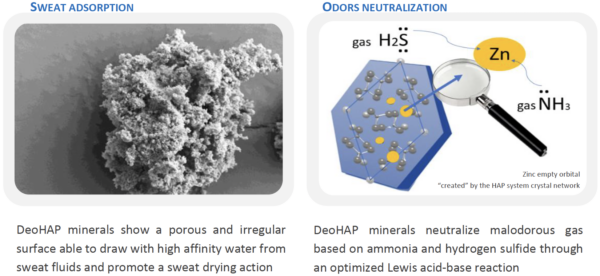
Supplier in-vivo gravimetric tests (DeoHAP DRY vs. placebo) show sweat-reduction values in the antiperspirant range with a single application, and odor-panel data support 24–48-hour protection claims when the active is used at recommended levels. These studies follow standard industry protocols and provide a credible performance benchmark for claim support.
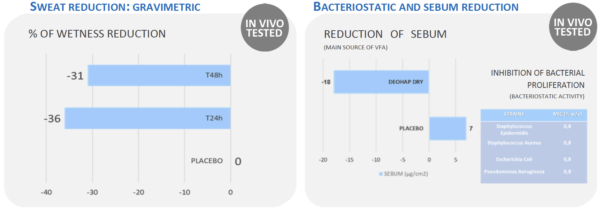
Beyond sweat and odor, DeoHAP DRY contributes to sebum management and surface texture. Literature on calcium phosphates in cosmetics notes their use as sebum-absorbing, surface-refining agents in both leave-on and rinse-off systems. In DeoHAP DRY, that translates into a smoother, less greasy underarm environment with less lipid substrate available to odor-forming bacteria—exactly the pathway outlined in Di Cicco’s review of axillary odor, where both sweat and sebaceous secretions fuel malodor formation.
DeoHAP DRY is also positioned as bacteriostatic rather than broadly bactericidal. The technology is described as microbiota-friendly and frames it as dialing down odor-driving taxa bacteria while keeping the broader community in balance. That approach aligns with microbiome studies showing that aggressive antiperspirant use can increase Actinobacteria and shift microbial profiles in ways that may not support long-term odor management.
Formulation Guidance: pH, Usage Levels, and Formats
One of the most practical advantages for formulators is pH flexibility. DeoHAP DRY’s adsorption-based mechanism allows you to work closer to skin-physiological pH instead of being locked into the low-pH regimes required by aluminum salts. Kalichem’s ingredient page and technical materials position DeoHAP DRY as non-irritating and pH-neutral, suitable for incorporation into a wide range of systems.
DeoHAP DRY is offered as powder and as aqueous suspensions (around 30% active) to simplify processing in roll-ons, sprays, sticks, creams, and pastes. Typical use levels in example formulas and distributor listings fall roughly in the 5–20% range, depending on format and claim intensity. For daily-use aluminum-free deodorants, development can start at the lower end of that range; for sports or “48 h” positioning, higher loadings and film-forming co-actives may be appropriate.
Because DeoHAP DRY has high surface area, you’ll want to pay careful attention to dispersion and rheology. Pre-dispersing the mineral in part of the aqueous phase or using the suspension grades can improve homogeneity; in sticks and anhydrous systems, pairing with appropriate structuring agents helps avoid chalkiness. The active itself is aluminum-free, alcohol-free, and fragrance-free, so it fits clean-label briefs and gives your fragrance and chassis room to carry the brand story.
Roll-on hyperfluid (20% DeoHAP DRY)
Prototype roll-on deodorant with quick absorption and suspended deodorizing minerals. Designed as a hyperfluid O/W emulsion.
- DeoHAP DRY level: 20.0%
- Key structure: OLIVOIL GLUTAMATE EMULSIFIER + light esters (coco-caprylate/caprate, dicaprylyl carbonate)
- Skin-care actives: panthenol, tocopheryl acetate, Chondrus crispus extract
- Rheology: xanthan gum + sclerotium gum for hyperfluid texture
- Recommended pH: final pH not below 5.5
Roll-on hyperfluid (10–20% DeoHAP DRY)
Alternative hyperfluid roll-on chassis using a different emulsifier system and volatile emollients.
- DeoHAP DRY level: 10.0–20.0%
- Key structure: OLIVOIL GLUTAMATE EMULSIFIER + cetearyl alcohol & coco-glucoside (Montanov 82)
- Emollients: coco-caprylate/caprate, dicaprylyl carbonate, undecane/tridecane
- Skin-care & texture: panthenol, tocopherol, xanthan/sclerotium gums, Chondrus crispus extract
- Recommended pH: final pH not below 5.5
Deodorant spray base (20% DeoHAP DRY)
Hydro-alcoholic deo spray with suspended DeoHAP DRY, designed for spray dispensers.
- DeoHAP DRY level: 20.0%
- Base: aqua 45.0% + alcohol denat. 34.7%
- Fragrance: parfum 0.3% (plus preservatives as needed)
- Format: low-viscosity sprayable suspension of mineral actives
- Recommended pH: final pH not below 5.5
DeoHAP DRY: Formulator FAQs
DeoHAP DRY is a biomimetic hydroxyapatite “Smartsorb” system that adsorbs sweat and malodorous gases on the skin surface instead of plugging sweat ducts. Supplier gravimetric tests versus placebo show wetness reduction in the antiperspirant range with 24–48 hour protection. You should still verify performance in your own chassis and protocol, but the data demonstrate that aluminum-free and high-performing can coexist in the same formula.
No. Unlike classical aluminum salts, DeoHAP DRY does not form gel plugs inside eccrine ducts. It remains at the skin surface as a mineral network that “drinks up” sweat and traps odor molecules. Natural perspiration and thermoregulation can continue, while the underarm feels drier and smells cleaner.
DeoHAP DRY is positioned as a bacteriostatic deodorant active. It helps reduce odor-relevant microbes instead of broadly sterilizing the axilla. That aligns with current thinking that effective odor control comes from managing sweat and sebum substrates and selectively influencing the bacteria that convert them into malodorous volatiles—rather than wiping out the entire microbial community.
In Kalichem prototypes, DeoHAP DRY is typically used around 7–20% active, depending on format and claim intensity—lower levels for everyday sticks and roll-ons, higher levels for 48 hour or sports-positioned concepts. Because the mechanism is adsorption, you can usually formulate near skin-like pH (about 5–7) instead of the very acidic pH used for aluminum salts. Always confirm exact ranges against the latest DeoHAP DRY technical data sheet and validate performance and stability in your own base.
Claim Building: What You Can Realistically Say
Taken together, the literature and technical data support a set of concrete, defensible claim territories around DeoHAP DRY:
▶︎ “Aluminum-free sweat and odor control” – DeoHAP DRY is explicitly positioned as aluminum-chlorohydrate/chloride-free and achieves antiperspirant-like wetness reduction in gravimetric tests.
▶︎ “Mineral sweat adsorber that does not block sweat glands” – the documentation consistently describes a surface adsorbing mechanism and contrasts it with traditional duct-occluding aluminum salts.
▶︎ “Microbiota-friendly, bacteriostatic deodorant active” – DeoHAP DRY is marketed as microbiota-friendly and bacteriostatic, and this is consistent with independent evidence that aggressive antiperspirant use can over-shift axillary microbiota.
▶︎ “Sebum-reducing, smoother underarm feel” – supported by calcium-phosphate literature on sebum absorption and surface refinement, and by DeoHAP DRY’s described ability to improve skin appearance and smoothness.
Ready to evaluate DeoHAP DRY in your next deodorant?
If you’re exploring aluminum-free deodorant systems that still deliver antiperspirant-like wetness and odor control, DeoHAP DRY is ready for the lab. Request documentation and samples, review the leaflet with your team, or forward this article to your Deveraux account manager to align on next steps.
Take DeoHAP DRY from concept to prototype.
Cosmetic use only; claims and availability vary by market. Confirm all claims, usage levels, and regulatory status with your internal team.
Related readings
-
Why DeoHAP DRY is the natural deodorant ingredient of tomorrow
Explore how DeoHAP DRY answers the “aluminum-free that actually works” brief with mineral sweat control and microbiome-respecting claims.
-
Rethinking sweat control: The science behind hydroxyapatite in deodorants
Dive deeper into biomimetic hydroxyapatite, adsorption mechanisms, and why mineral actives are reshaping next-gen deodorant design.
-
Meet Kalichem’s eco-friendly unicorns
See where DeoHAP DRY sits within Kalichem’s portfolio of high-performance, eco-conscious actives that support cleaner deo stories.
-
Emotional beauty: Bridging the gap between skin and self
Connect functional actives like DeoHAP DRY to routines that support comfort, confidence, and emotional well-being in daily care.
Resources:
- Carella, F., Degli Esposti, L., Adamiano, A., & Iafisco, M. (2021). The use of calcium phosphates in cosmetics, state of the art and future perspectives. Materials, 14(21), 6398. https://doi.org/10.3390/ma14216398
- Callewaert, C., Hutapea, P., Van de Wiele, T., & Boon, N. (2014). Deodorants and antiperspirants affect the axillary bacterial community. Archives of Dermatological Research, 306(8), 701–710. https://link.springer.com/article/10.1007/s00403-014-1487-1
- Di Cicco, F., Evans, R. L., James, A. G., Weddell, I., Chopra, A., & Smeets, M. A. M. (2023). Intrinsic and extrinsic factors affecting axillary odor variation: A comprehensive review. Physiology & Behavior, 270, 114307. https://doi.org/10.1016/j.physbeh.2023.114307
- Kalinowska-Lis, U. (2025). Overview of active ingredients used in deodorants and antiperspirants available on EU market. Applied Sciences, 15(9), 5068. https://www.mdpi.com/2076-3417/15/9/5068
- Teerasumran, P., Velliou, E., Bai, S., et al. (2023). Deodorants and antiperspirants: New trends in their active agents and testing methods. International Journal of Cosmetic Science, 45(4), 426–443. https://pmc.ncbi.nlm.nih.gov/articles/PMC10946881/
The external resources cited in this blog were selected to give formulators and brands a solid, independent foundation beneath the DeoHAP DRY story: peer-reviewed papers on deodorant/antiperspirant actives, axillary microbiology, and calcium phosphates in cosmetics provide objective context on mechanisms of action, pH behavior, microbiome impact, and sebum/odor pathways, while supplier and Deveraux materials supply ingredient-specific data on usage levels, formats, and gravimetric performance; taken together, this mix of sources helps R&D, regulatory, and marketing teams align on what DeoHAP DRY can credibly claim, how it differs from classical aluminum salts, and how to position aluminum-free, microbiome-respecting deodorant systems with defensible technical backing.