Executive Summary
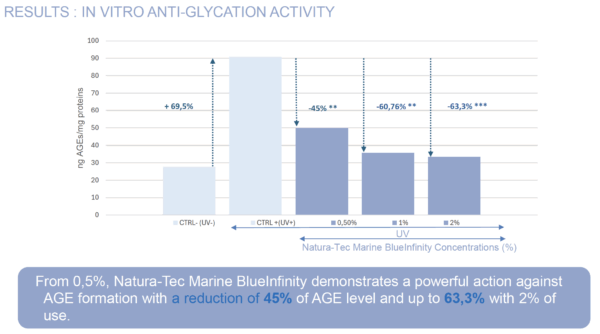
Most photo-aging strategies focus on UV filters and antioxidants, yet visible aging can still progress through a structural pathway: glycation, where sugars form advanced glycation end products (AGEs) that stiffen collagen and undermine elasticity over time. In supplier testing, Natura-Tec Marine BlueInfinity™ (INCI: Squalane (and) Haematococcus Pluvialis Extract) helped limit AGE formation in dermal fibroblasts exposed to repeated UV, reporting up to ~63.3% AGE reduction at 2% (in vitro). In an in vivo comparison under intensive solar exposure, a formula with 2% Marine BlueInfinity™ supported improvements in key photo-aging parameters, including skin elasticity, wrinkle visibility, and skin density over time—helping formulators build “beyond SPF” anti-aging narratives grounded in a measurable mechanism.
Most anti-aging formulations are designed to defend skin from damage—yet many overlook one of the most destructive processes happening beneath the surface.
Ultraviolet radiation, oxidative stress, and inflammation are well understood contributors to visible skin aging. Entire product categories have been built to address them. Sunscreens block UV. Antioxidants neutralize reactive oxygen species. Retinoids stimulate cellular turnover. These approaches are effective, measurable, and supported by decades of research.
And yet, even in well-protected skin, collagen continues to stiffen, wrinkles deepen, and elasticity declines—particularly in individuals exposed to daily sunlight. This inconsistency points to a missing mechanism. That mechanism is glycation.
What Glycation Really Does to Skin Structure
Glycation is not an abstract biochemical concept. It is a direct chemical reaction between sugars and proteins that occurs without enzymatic control. In the skin, those proteins are collagen and elastin—the fibers responsible for firmness, elasticity, and mechanical resilience.
When sugars bind to these structural proteins, they form advanced glycation end products (AGEs). Unlike healthy collagen, glycated collagen becomes stiff, brittle, and resistant to normal enzymatic breakdown. Over time, this leads to reduced elasticity, increased wrinkle formation, and a loss of skin density that no surface-level smoothing agent can reverse.
Crucially, glycation is not limited to intrinsic aging. UV exposure accelerates the formation of AGEs by increasing oxidative stress and triggering inflammatory signaling pathways. This is why photo-aged skin often appears thickened, less elastic, and more deeply wrinkled—even when protected by sunscreen alone.
Understanding Glycation: A Structural Threat to Skin Integrity
Glycation is a non-enzymatic chemical reaction in which sugars bind to proteins and lipids. In skin, the most vulnerable targets are collagen and elastin, the structural proteins responsible for firmness, elasticity, and tensile strength.
When these proteins become glycated, they form advanced glycation end products (AGEs). Unlike healthy collagen fibers, glycated collagen becomes rigid and resistant to normal enzymatic breakdown. The result is a gradual loss of flexibility, impaired remodeling of the dermal matrix, and a visible decline in skin quality that cannot be corrected at the surface.
Importantly, glycation is cumulative. Once AGEs form, they persist. Over time, they compromise the skin’s ability to respond to repair signals, accelerating the visible signs of aging even in otherwise well-maintained skin.
Why UV Exposure Accelerates Glycation in Skin
Glycation is often associated with intrinsic aging, but extensive research shows that UV exposure significantly accelerates AGE formation. Ultraviolet radiation increases oxidative stress and inflammation, both of which create favorable conditions for glycation reactions.
AGEs interact with specific cellular receptors known as RAGE (Receptor for Advanced Glycation End Products). Activation of the AGE–RAGE pathway triggers inflammatory signaling, reactive oxygen species production, and further matrix degradation. This creates a feedback loop: UV exposure increases glycation, glycation amplifies inflammation, and inflammation accelerates structural aging.
This explains a critical limitation in many anti-aging products. While antioxidants may reduce oxidative stress, they do not prevent collagen from becoming chemically cross-linked by sugars. Without interrupting glycation, UV-protected skin can still age at the structural level.
Why Antioxidants and Sunscreens Are Necessary—but Not Sufficient
Sunscreens remain essential for preventing DNA damage and acute photo-injury. Antioxidants help neutralize free radicals generated by environmental stressors. These strategies address important aspects of skin protection.
However, neither approach directly targets collagen glycation. Once collagen fibers are cross-linked by AGEs, their mechanical properties change permanently. They become stiffer, less elastic, and more resistant to turnover. No amount of surface hydration or short-term smoothing can reverse this process.
Effective photo-aging protection must therefore operate on multiple levels. It must defend against UV damage, limit oxidative stress, and preserve the biochemical integrity of the dermal matrix. Anti-glycation strategies address the third—and often neglected—component.
Anti-Glycation Skincare: Preserving the Dermal Matrix from Within
Anti-glycation actives work by limiting the formation of AGEs and reducing the downstream inflammatory signaling associated with the AGE–RAGE pathway. By doing so, they help maintain collagen flexibility, enzymatic accessibility, and proper interaction with surrounding cells.
From a formulation perspective, this translates into long-term preservation of skin elasticity, wrinkle resistance, and density, rather than short-lived cosmetic effects. Anti-glycation skincare is not about rapid transformation. It is about structural maintenance over time—especially in environments where UV exposure is unavoidable.
Despite its relevance, anti-glycation remains underutilized in modern formulations, in part because effective solutions must demonstrate real-world performance and integrate cleanly into existing formulation systems.
Microalgae-Derived Carotenoids: A Biologically Proven Defense
Microalgae offer a compelling solution to the glycation challenge. Exposed to intense solar radiation in marine environments, these organisms have evolved powerful protective systems centered on carotenoids, molecules known for their ability to regulate oxidative and inflammatory stress.
Haematococcus pluvialis is particularly significant. It is the richest natural source of astaxanthin, a carotenoid extensively studied for its antioxidant and anti-inflammatory activity. In addition to astaxanthin, the microalga contains complementary carotenoids that support cellular resilience under environmental stress.
By reducing oxidative stress and inflammatory signaling, carotenoids help limit the conditions that promote AGE formation—making them a biologically logical foundation for anti-glycation skincare.
Marine BlueInfinity: Anti-Glycation Performance Under Real Solar Exposure
Natura-Tec Marine BlueInfinity translates this biological logic into a formulation-ready cosmetic active. It combines carotenoid-rich Haematococcus pluvialis extract with olive-derived squalane, an emollient known for its exceptional skin affinity and barrier compatibility.
This composition is not incidental. While carotenoids provide biological activity, squalane enhances delivery and supports the skin barrier, creating an optimal environment for the active components to function effectively.
In vitro testing demonstrates that Marine BlueInfinity significantly reduces AGE formation in dermal fibroblasts exposed to repeated UV stress, with reductions exceeding 60% at commercially relevant use levels. This directly confirms its anti-glycation mechanism under photo-aging conditions.
Clinical Evidence: Measurable Benefits Where It Matters
Laboratory results are only meaningful if they translate into visible outcomes. To assess real-world relevance, Marine BlueInfinity was evaluated in vivo under intensive solar exposure conditions.
Formulations containing the active demonstrated early and sustained improvements in skin elasticity, followed by reductions in wrinkle visibility and increases in skin density over time. These effects were observed even when volunteers were exposed daily to summer sunlight—a scenario that typically accelerates structural aging.
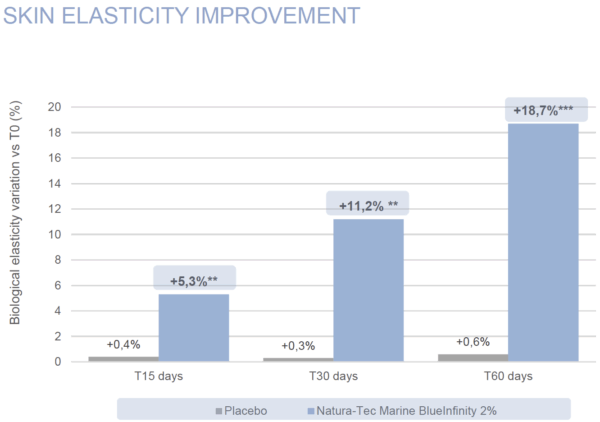
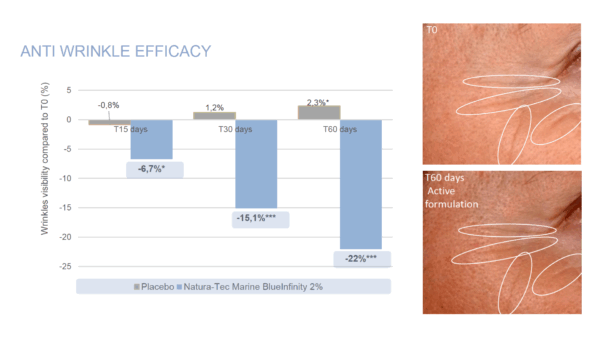
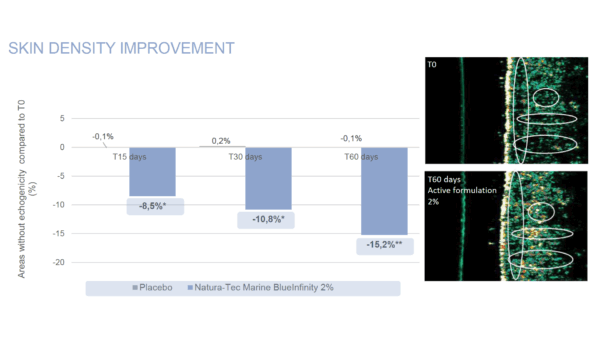
Equally telling is the comparison with placebo formulations. Under the same exposure conditions, placebo-treated skin showed no protective benefit, and in some cases, visible aging progressed. This contrast highlights the role of anti-glycation protection in preserving dermal structure where conventional approaches fall short.
Formulation Advantages for Modern Product Development
Beyond performance, Marine BlueInfinity is designed with formulators in mind. It is oil-soluble, compatible with emulsions and anhydrous systems, and incorporated during the cooling phase, reducing processing constraints.
Recommended use levels between 0.5% and 2% provide flexibility across product formats, from daily moisturizers to anti-aging products intended for sun-exposed skin.
The ingredient also aligns with current market expectations. It is COSMOS-approved, palm-free, non-GMO, and 100% natural origin, allowing brands to address advanced aging mechanisms without compromising clean beauty positioning.
Why Anti-Glycation Is Becoming Essential in Photo-Aging Protection
Skin aging is not driven by a single pathway. It is the cumulative result of chemical, mechanical, and inflammatory processes acting over time. Glycation represents one of the most damaging of these processes because it alters the physical properties of collagen itself.
Addressing glycation early—particularly in products designed for daily UV exposure—offers a more durable approach to maintaining youthful skin structure. Anti-glycation actives do not replace sunscreens or antioxidants; they complete the protection strategy by safeguarding the dermal matrix.
For formulators focused on long-term performance, anti-glycation is no longer a niche concept. It is a structural necessity.
Marine BlueInfinity FAQs
Typical use levels are 0.5–2.0%, depending on the format and desired positioning. For daily facial moisturizers and anti-wrinkle emulsions, many formulators start around 0.5–1%, while sun-exposed anti-aging products and “intensive” routines often sit closer to 2%. As always, align the final level with your claim strategy, sensory targets, and regional guidance.
Marine BlueInfinity™ is an oil-soluble active designed for straightforward processing. In emulsions, add it during the cooling step to support stability of sensitive components and to keep the process simple. It is also suitable for anhydrous formats (like facial oils) and can be used across a range of product types where an oil phase is present.
The ingredient is described as colorless to pale yellow, so most systems can maintain a clean aesthetic when used at typical levels. Sensory-wise, the presence of squalane supports a lightweight, skin-compatible feel, which can be especially helpful when building daily-use anti-aging textures that need to feel comfortable under real-world wear.
Yes—its positioning is tied to glycation control under UV stress. In testing, Marine BlueInfinity™ reduced AGE formation in dermal fibroblasts exposed to repeated UV, and in an in vivo protocol under sustained solar exposure it supported improvements in skin parameters associated with photo-aging (including elasticity and wrinkle visibility) when used at 2% in a basic formula.
Marine BlueInfinity™ is described as 100% natural origin and COSMOS approved, with additional positioning notes including palm-free and non-GMO. That combination can help teams build anti-glycation and anti-aging narratives while still meeting modern expectations for naturality and responsible sourcing.
Completing the Framework of Skin Aging Protection
Photo-aging cannot be solved by surface-level solutions alone. While UV protection and antioxidants remain critical, they do not prevent collagen from becoming chemically compromised by sugars.
By integrating anti-glycation protection into modern formulations, cosmetic scientists can move beyond symptom management toward structural preservation. Marine BlueInfinity offers a scientifically validated, formulation-friendly way to address one of the most overlooked drivers of skin aging—protecting skin where aging truly begins.
Ready to Formulate for Anti-Glycation Protection with Marine BlueInfinity?
Take the next step from insight to action. Download the Marine BlueInfinity PDS, review the data, and put anti-glycation protection to work in your next launch.
Download the Marine BlueInfinity brochure (PDF) Send a doc/sample requestRelated Reading
Resources
- Pageon, H. (2021). UVA exposure combined with glycation of the dermis are two crucial factors involved in photoaging development: A narrative review. Clinical, Cosmetic and Investigational Dermatology. https://pmc.ncbi.nlm.nih.gov/articles/PMC8563119/
- Gkogkolou, P., & Böhm, M. (2012). Advanced glycation end products: Key players in skin aging? Dermato-Endocrinology, 4(3), 259–270. https://pmc.ncbi.nlm.nih.gov/articles/PMC3583887/
- Crisan, M., et al. (2013). Expression of advanced glycation end-products on sun-exposed and sun-protected skin: A histological and immunohistological study. PLOS ONE, 8(9), e75003. https://journals.plos.org/plosone/article?id=10.1371/journal.pone.0075003
- Lee, E. J., et al. (2016).Advanced glycation end products (AGEs) promote melanogenesis through receptor for AGEs. Scientific Reports, 6, 27848. https://www.nature.com/articles/srep27848
- Chen, C., et al. (2022). Advanced glycation end products in the skin: Molecular mechanisms, methods of measurement, and inhibitory pathways. Frontiers in Medicine. https://www.frontiersin.org/journals/medicine/articles/10.3389/fmed.2022.837222/full
Citation note:
These references were selected because they are peer-reviewed, open-access sources that collectively support the full story brands need to market anti-glycation claims responsibly: they explain what glycation and AGEs are, why UV exposure accelerates AGE formation and photo-aging, and how AGE–RAGE signaling links to inflammation and structural collagen changes, while also including human skin evidence comparing sun-exposed vs. sun-protected areas. Using open-access literature allows product teams, regulators, and customers to verify the science directly, strengthens claim substantiation and internal alignment across R&D and marketing, and reduces risk of overstatement by grounding messaging in transparent, citable data that supports education, positioning, and compliant communications.